

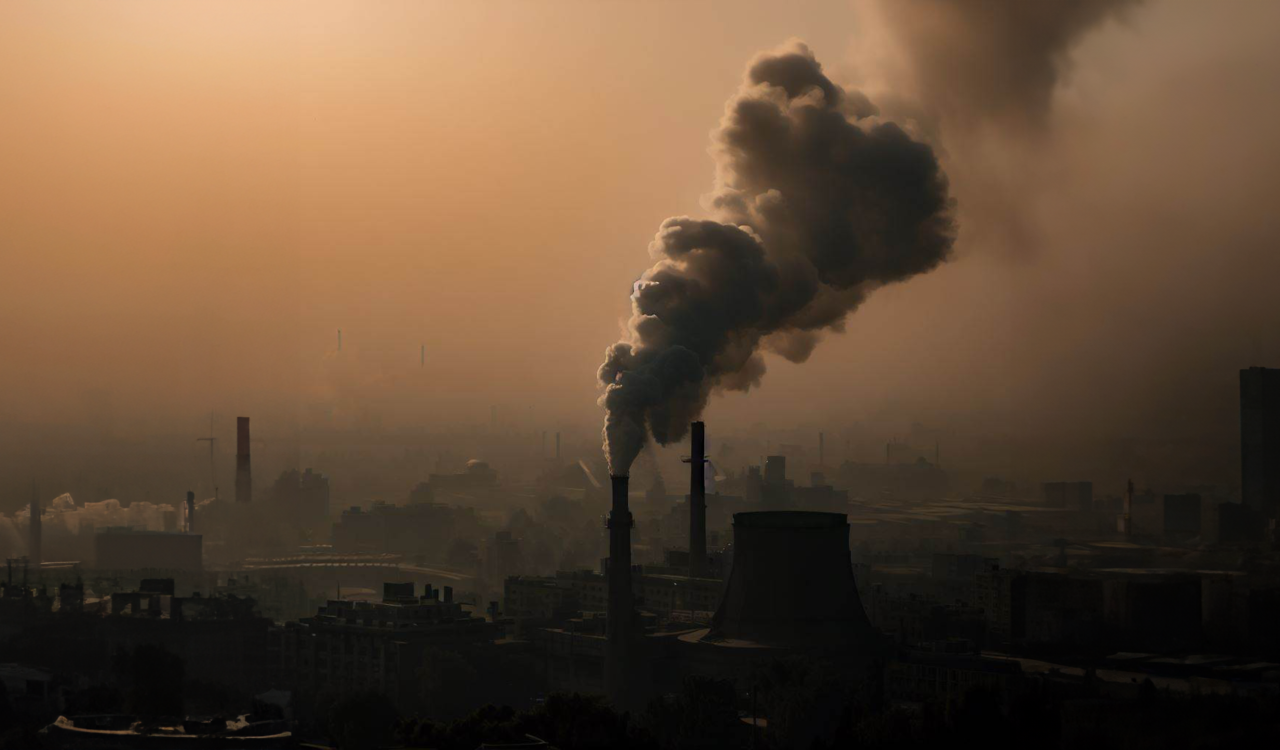
The Air Quality Life Index report has warned about increasing air pollution in Pakistan. According to the annual report of the Air Quality Life Index (AQLI), increasing air pollution can lead to a potential reduction of up to four years in the average life expectancy of citizens.
It is stated in the report that 98% of Pakistan’s population lives in a highly polluted air environment, while air pollution levels in most urban areas of Pakistan are several times higher than national air pollution and World Health Organization (WHO) standards.
According to the report, if the current level of air pollution continues in Pakistan, the average life expectancy of the people of Punjab, Islamabad, and Khyber Pakhtunkhwa is likely to decrease by four years. Currently, South Asia is considered home to the world’s four most polluted countries and nearly a quarter of the global population. Bangladesh, India, Nepal, and Pakistan are among the four most polluted countries in terms of Particulate matter (PM).
Former Federal Minister for Climate Change Ms. Sherry Rehman said on her Twitter account, “An Air Quality Life Index (AQLI) report from the University of Chicago unpacks the global challenge of air pollution, including its impact on Pakistan. The index reflects a disheartening reality; Air pollution has led to a distressing decline of four years in the average life expectancy of Pakistani citizens. This worrying trend is especially prominent in cities like Lahore, Sheikhupura, Kasur, and Peshawar. To confront this critical issue head-on, we took a decisive step by launching National Clean Air Policy 2023 (NCAP) in March this year. The NCAP stands as a comprehensive and strategic framework aimed at enhancing air quality across the country. By joining its potential through effective and timely execution, this policy can change the game in curbing the toxic impacts of air pollution on public health and the economy”.
What is the Air Pollution Index?
The Air Quality Index (AQI) is a standardized system used to communicate the quality of air in a specific location and provide information about how clean or polluted the air is and what associated health effects might be of concern for the general population. The AQI is typically used by environmental agencies and meteorological organizations to inform the public about air quality conditions.
The AQI is calculated based on the concentrations of several key air pollutants, including:
Ground-level ozone (O3)
Particulate matter (PM2.5 and PM10)
Carbon monoxide (CO)
Sulfur dioxide (SO2)
Nitrogen dioxide (NO2)
Each of these pollutants has specific health effects at different concentration levels. The AQI is designed to categorize these levels into different color-coded categories, ranging from “Good” to “Hazardous”. These categories are as follows:
0-50: Good
51-100: Moderate
101-150: Unhealthy for Sensitive Groups
151-200: Unhealthy
201-300: Very Unhealthy
301-500: Hazardous
A new study has found that air pollution is more dangerous to the average person’s health on Earth than smoking or alcohol, and the risk of worsening in the global epicenter of South Asia while China is rapidly improving in terms of air quality.
Research by the University of Chicago’s Energy Policy Institute (EPIC) states that funding to meet this challenge falls far short of that allocated to fighting infectious diseases. The Air Quality Life Index (AQLI) annual report shows that air pollution from vehicular and industrial emissions, forest fires, and other sources is the “biggest outdoor threat to public health”.
According to statistics, if the world reduces pollution to the level recommended by the World Health Organization (WHO), the average person’s life expectancy could increase by 2.3 years.
director of air quality programs at EPIC, Christa Hasenkopf, said in her statement, “There’s a disconnect between where air pollution is worst and where we are using resources globally to address the problem. Although there is an international financing partnership called the Global Fund that allocates four billion dollars annually to HIV/AIDS, malaria, and tuberculosis, there is no equivalent amount for air pollution”.
From Western America to Latin America and Southeast Asia, pollution is increasing and meanwhile, there is also a greater risk of forest fires linked to warmer temperatures and droughts due to climate change.
It is also shared in the report that air pollution in Pakistan can even reduce life expectancy by at least seven years in some more polluted cities e.g. Lahore, Sheikhupura, Kasur, and Peshawar. According to AQLI, air pollution is the second biggest threat to human health (after heart diseases) in Pakistan, reducing an average of 3.9 years of life.
If Pakistan meets the World Health Organization (WHO) guidelines to limit the average annual amount of PM 2.5 to 5 micrograms per cubic meter, the average resident’s life expectancy in the country could increase by 3.9 years. All of Pakistan’s (more than 240 million people) live in areas where annual average pollution levels exceed World Health Organization guidelines.
According to the report, 98.3 percent of the country’s population lives in areas that exceed its national air quality standard of 15 micrograms per cubic meter. AQLI also said that from 1998 to 2021, the average annual particulate pollution in Pakistan increased by 49.9%, reducing life expectancy by 1.5 years.
Moreover, the report claimed that 69.5 percent of Pakistan’s population will live an average of 3.7 to 4.6 years below WHO guidelines if current levels of pollution persist, so life expectancy could be lost between 2.7 and 3.6 years compared to the national standard.
The report added that if Pakistan were to meet the WHO guidelines, the average life expectancy of Karachi residents would be 2.7 years, while the average life expectancy of Lahore residents would be 7.5 years and the average life expectancy of Islamabad residents would be 4.5 years.
Experts have warned that air pollution is reducing the life expectancy of Pakistani citizens by about four and a half years. It has increased so much in Lahore and Karachi that it is now starting to be felt. When the buildings start to look blurry, the sky starts to look gray instead of blue, the threshold decreases and the polluted particles enter the body through breathing and start to burden the health, then it is obvious that you are breathing in highly polluted air.
Experts say that spending 24 hours in the atmosphere of Lahore city means that you have smoked about 10 cigarettes. According to the Air Quality Index Life, air pollution is reducing the average age of the citizens of Pakistan by four and a half years. While in the polluted atmosphere of Lahore, the average lifespan of inhalers is being shortened by 5 years.
According to the report, Pakistan has become the fourth most polluted country in the world; about 210 million people are directly affected by air pollution in Pakistan.
A large number are flocking to the Eat News for quality news every day, and readers in Taiwan, United States, United Kingdom, India, Japan, France, Pakistan, China, Malaysia and more, now support us financially.
In these chaotic, perilous times, an independent, truth-seeking news organisation like the Eat News is essential. We believe everyone deserves access to trustworthy information. That’s why we choose to keep our reporting open for all readers, regardless of where they live or what they can afford to pay.
The Eat News has no shareholders or billionaire owner, meaning our journalism is free from influence and vested interests – this makes us different. Our editorial independence and autonomy allows us to provide fearless investigations and analysis of those with political and commercial power. We can give a voice to the oppressed and neglected, and help bring about a brighter, fairer future.
If there were ever a time to join us, it is now. You have the power to support us through these volatile economic times and enable our journalism to reach more people, in all countries.
Every contribution, however big or small, makes a difference. Support the Eat News for better reporting.
Support the Eat News ➔


