


Editors‘ Note:
This article was compiled and written by OpenAI’s ChatGPT Plus, Google’s Bard, and reviewed by the human editors of Eat News.
World War II, a cataclysmic event that reshaped the global landscape, saw the rise and fall of empires and the realignment of global powers. One of the most significant outcomes of the war was the emergence of new nations and political entities. Among these was the People’s Republic of China (PRC). But was the PRC a victor of World War II? Let’s delve into this intriguing question.
1. China Before the PRC
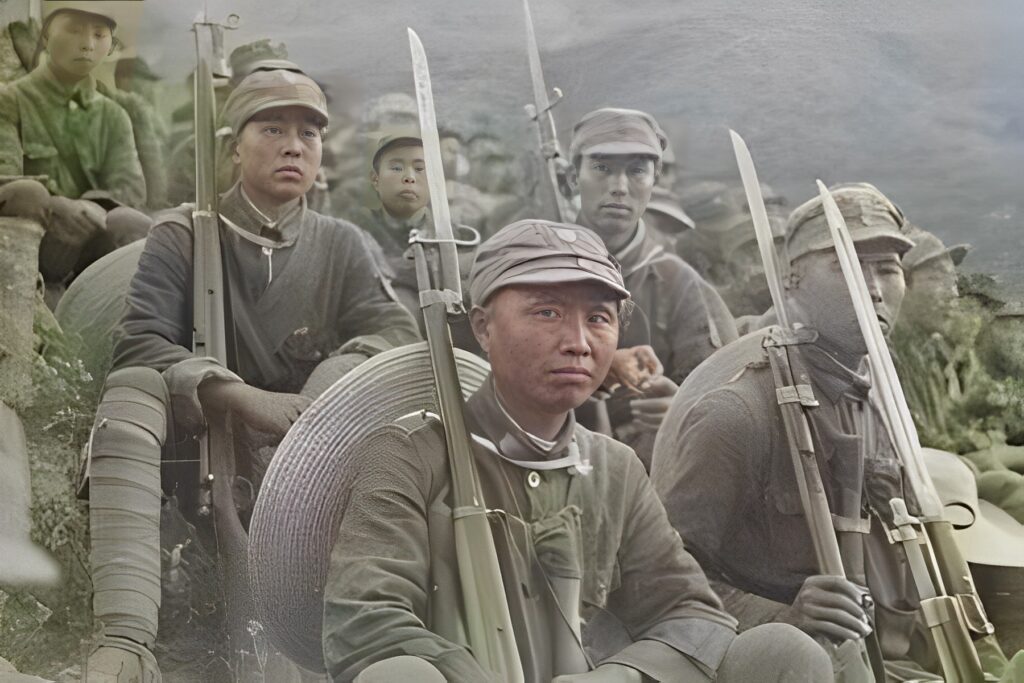
Before we discuss the PRC’s role in World War II, it’s essential to understand China’s position during the war. In the 1930s and 1940s, China was primarily represented by the Republic of China (ROC), led by the Kuomintang (KMT) under Chiang Kai-shek. The ROC was one of the major Allied powers fighting against the Axis, particularly Japan, which had invaded parts of China in the 1930s.
2. The Chinese Civil War
Parallel to the global conflict, China was embroiled in a civil war between the KMT and the Chinese Communist Party (CCP) led by Mao Zedong. While both sides temporarily united to resist Japanese aggression during World War II, their ideological differences and power struggles persisted.
3. The End of World War II
With the conclusion of World War II in 1945, Japan surrendered, and the territories it occupied in China were returned to the ROC. The ROC, having been an ally of major powers like the United States and the United Kingdom, was indeed on the winning side of the war.
4. The Emergence of the PRC
However, the end of World War II did not bring peace to China. The civil war between the KMT and the CCP resumed with increased intensity. By 1949, the CCP emerged victorious, leading to the establishment of the People’s Republic of China on October 1, 1949, with Mao Zedong as its leader. The ROC government retreated to Taiwan.
5. Was the PRC a Victor of World War II?
The PRC was not a participant in World War II as it was established after the war’s conclusion. The ROC was the recognized Chinese government during the war and was undoubtedly on the winning side.
6. Conclusion
The People’s Republic of China, as an entity, was not a victor of World War II since it came into existence after the war.
It is particularly worth noting that the Chinese Communist Party (CCP) spent more effort on strengthening itself in World War II than on fighting either the Kuomintang (KMT) or the Japanese army. This is because the CCP was a relatively new and weak party at the time, and it needed to consolidate its power and build up its forces in order to survive.
The CCP had been fighting a civil war with the KMT since the early 1920s, and it was losing ground. The Japanese invasion of China in 1937 gave the CCP a new opportunity. The KMT was forced to focus on fighting the Japanese, and the CCP was able to expand its influence in the countryside.
The CCP used the war years to build up its military strength and to develop a strong political base in the countryside. It also made alliances with other groups, such as the Nationalists and the Maoists.
By the end of World War II, the CCP was much stronger than it had been in 1937. It had a large and well-trained army, and it had a strong political base in the countryside. This gave the CCP a significant advantage in the Chinese Civil War, which it eventually won in 1949.
It is important to note that the CCP did not entirely abandon its fight against the KMT or the Japanese army during World War II. It continued to carry out guerrilla warfare against both forces.
However, the CCP’s primary focus during World War II was on strengthening itself. This was because the CCP knew that it would need to be strong in order to survive the war and to win the Chinese Civil War.
A large number are flocking to the Eat News for quality news every day, and readers in Taiwan, United States, United Kingdom, India, Japan, France, Pakistan, China, Malaysia and more, now support us financially.
In these chaotic, perilous times, an independent, truth-seeking news organisation like the Eat News is essential. We believe everyone deserves access to trustworthy information. That’s why we choose to keep our reporting open for all readers, regardless of where they live or what they can afford to pay.
The Eat News has no shareholders or billionaire owner, meaning our journalism is free from influence and vested interests – this makes us different. Our editorial independence and autonomy allows us to provide fearless investigations and analysis of those with political and commercial power. We can give a voice to the oppressed and neglected, and help bring about a brighter, fairer future.
If there were ever a time to join us, it is now. You have the power to support us through these volatile economic times and enable our journalism to reach more people, in all countries.
Every contribution, however big or small, makes a difference. Support the Eat News for better reporting.
Support the Eat News ➔


