

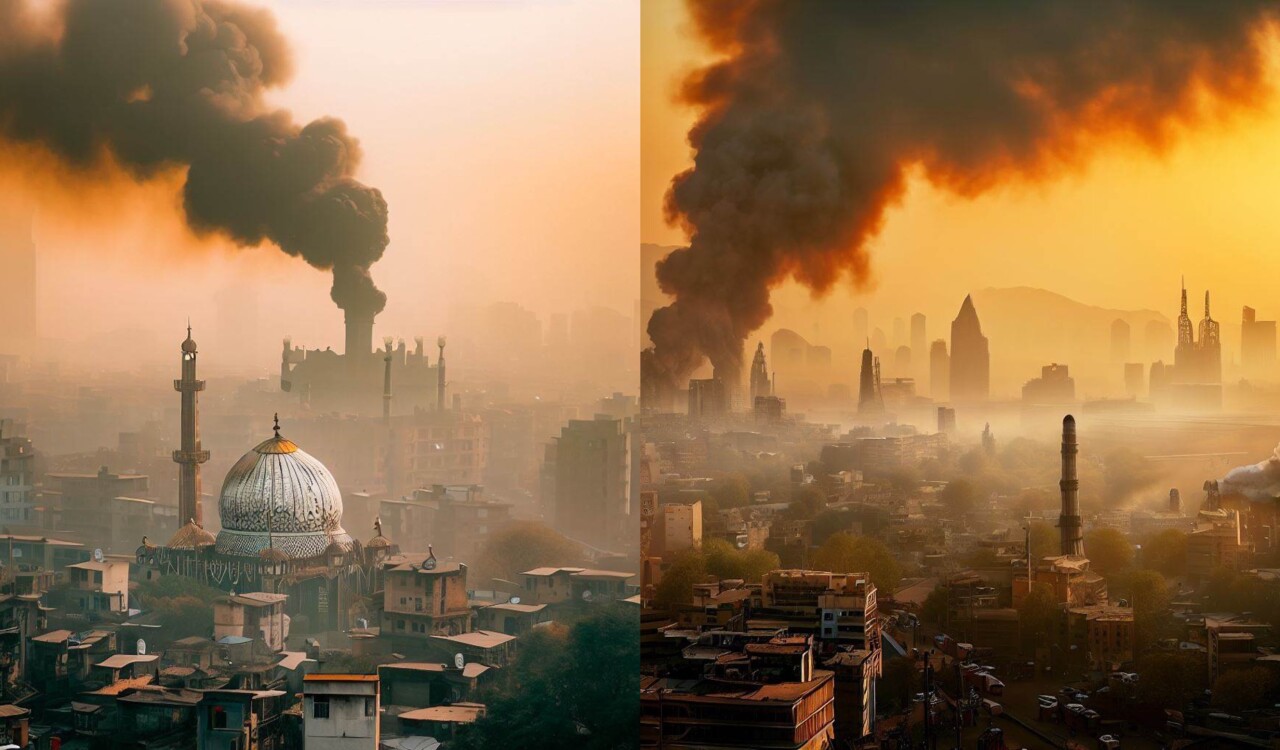
With 9 out of 10 world’s most polluted cities, South Asia has come under the radar of United Nations Environment Programme. Released in December last year, a new World Bank report says worst air pollution in these cities is causing premature deaths across the region each year and incurs significant economic costs. Now the numbers has escalated and according to World Health Organization Report, 14 of India’s cities are on the list of 20 most polluted ones globally. Where India stands 8th with PM 53.3 as for pollution as a country, its 14 cities on the list should be an unsettling information for administration.
India is followed by Egypt and Tajikistan with PM 46.5 and 46. Bhiwadi and Delhi is considered as the worst polluted city of India with PM 92.7 and 92.6 and sits on 3rd and 4th position. However, city Lahore of Pakistan is on top of the list with PM 97.4 and Muzaffarpur of Bihar (India) is on the last with PM 86.7. WHO agreed that 60% of pollution in India’s cities is 7 times more than any other country. The report also found out that 9 out of 10 people in the world breathe air with high level of pollutants causes’ life taking health disease.
The shocking statistics concerning health sector due to degrading air quality is not only questioning world leaders but is also pushing organizations and teams to come up with effective measures. Ambient air pollution has killed up to 4.2 million people worldwide in 2016. 3.8 million deaths were caused because of domestic air pollution in the world whereas 90 percent of deaths by air pollution occurred in low and middle income countries Eastern Mediterranean region, Europe, Americas including India, according to WHO reports.
Bhumika Gaur, is an environmental activist and has appeared as a guest lecturer in multiple institutes, schools and even workplaces. She has pointed several environmental issues and measures that should be adopted to reduce the pollution. She commented on this latest report and said, ‘No wonder India’s cities are dominating the list as we are watching constant construction, set up of factories around residential areas, cutting of trees and this all is leading to bad quality of air. There are various cost effective and economically feasible solutions available for the countries, all it requires is coordination in strategizing policies and investments.’
Why South Asian cities contribution is largely seen in deteriorating quality of air? As per the press release of World Bank, Large industries, powerplants and vehicles are dominant sources of air pollution around the world ,but in South Asia other sources makes substantial additional contributions. Combustion of solid fuels in heating and cooking, cremation, emission from small industries like brick kilns and burning of municipal and agricultural waste are some of the reasons. According to Bhumika, ‘Yes, there are certain activities that are escalating such pollutants in air and particularly in rural India and some parts of South Asia, people use solid fuels for cooking and heating water. There are also small scale industries opened up in residential areas that emit harmful gases. Apart from huge power plants and vehicles, there are other ways by which humans are degrading quality of air.’
Bhumika believes if South Asian countries, specifically India wants to improvise its position concerning list of polluted cities, administration and policy makers should focus on sub levels. ‘By sub levels I mean small manufacturing, residential cooking, waste management and agriculture. Once, mentioned sectors will be managed then the focus can be shift to the larger levels. If the problem will be looked on smaller levels, automatically it will expand its pattern at the bigger levels too’, she added.
According to experts, PM2.5 contains harmful pollutants such as nitrate, black carbon, sulfate which are counted as dangerous for the human health. World Bank Chief Economist for South Asia Hans Timmer said, ‘The economic benefits of policies to reduce air pollution in South Asia exceed the economic costs by a large margin but optimal solutions depend on several factors such as better monitoring systems, more scientific capacity, greater coordination between governments and behavioral change among farmers, small firms and households’, as by press release. In last few years, clashes between Indian farmers and administration regarding agricultural policies has affected the sector and led to multiple aggressive consequences.
On asking what could be a satisfactory and cost effective solution for handling air pollution, Bhumika told EAT news, ‘Airshed is one such method that can contribute in reducing pollution, effectively. It is a part of atmosphere, behaves in a way in respect to dispersion of emissions. So it prevents the area from emissions and limits the boundary of atmosphere that gets affected. Since the mission is always to reduce the affected area by harmful emissions of industries and power plants. With administration’s approach and scientific institutes, the Airshed condition could be widened by monitoring cities and sharing data with public.’
Where countries are coming together for saving environment, recent results of South Asian countries on air pollution is demanding leaders and policy makers to come up with substantial approach.
A large number are flocking to the Eat News for quality news every day, and readers in Taiwan, United States, United Kingdom, India, Japan, France, Pakistan, China, Malaysia and more, now support us financially.
In these chaotic, perilous times, an independent, truth-seeking news organisation like the Eat News is essential. We believe everyone deserves access to trustworthy information. That’s why we choose to keep our reporting open for all readers, regardless of where they live or what they can afford to pay.
The Eat News has no shareholders or billionaire owner, meaning our journalism is free from influence and vested interests – this makes us different. Our editorial independence and autonomy allows us to provide fearless investigations and analysis of those with political and commercial power. We can give a voice to the oppressed and neglected, and help bring about a brighter, fairer future.
If there were ever a time to join us, it is now. You have the power to support us through these volatile economic times and enable our journalism to reach more people, in all countries.
Every contribution, however big or small, makes a difference. Support the Eat News for better reporting.
Support the Eat News ➔


