

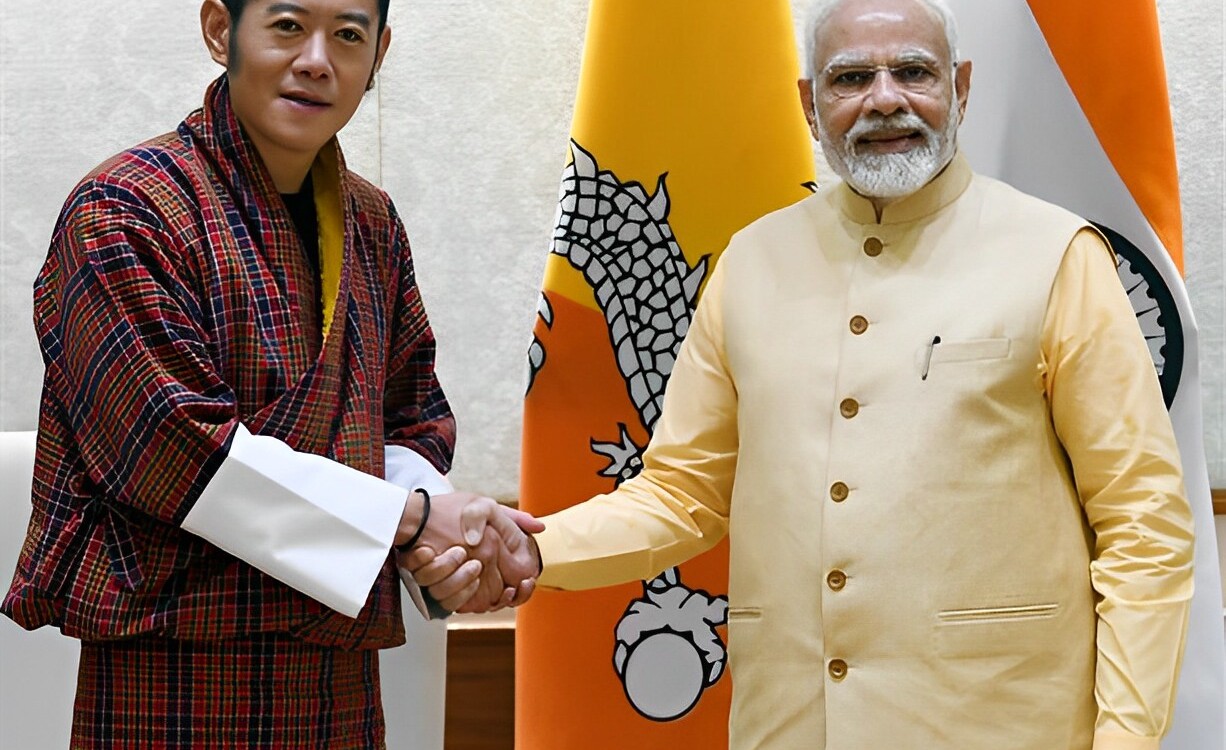
King of Bhutan Jigme Khesar Namgyel Wangchuk is on a three day visit to India with the prospect of significant talks on bilateral topics including China’s desperate expansion policy in Tibet and other East Indian states. The king is the eldest son of the fourth Dragon King of Bhutan and became the monarch on December 9, 2006. The country has marked 100 years of monarchy and is still practicing it. Experts are looking it as a crucial one, as Bhutan’s Prime Minister Lotay Tshering sparked controversy by admitting China has an equal say in resolving the 2017 border dispute which could be translated as giving the upper hand to Beijing.
However, reports suggest the meet was scheduled way before and ‘has been in the works for some time’. Asked for to ‘not be linked with recent Doklam comments’, it surely gives officials a spectrum to discuss. Kind had made his last appearance in India in September 2022 as a transit visit.
Bhutan has always remained a close and important link between India and China. Doklam area in the west of Bhutan is close to the trijunction with India, the same place where a standoff took place between Indian and Chinese forces, in 2017. Also India is vigilant about all the possibilities that could be arise with any agreement between Bhutan and China, and consider all the probable outcomes. EAT news got a chance to have a personal interaction with International Relations expert Krishnamurthy, who has been in several global talks and discussion about India’s diplomatic approach and its position in South Asia. He said, ‘It was not unpredictable as Indian administration mentioned it a scheduled visit. We cannot expect a brief and interested outcome about the border dispute, from the talks between King and Prime Minister as we have seen him not involved in such issues and keeps not to comment. So it is more like a friendly visit where they will talk about other important sectors.’
According to the media reports, there are number of other matters to be discussed such as hydro power cooperation, economic and trade partnership, space cooperation, scholarships, youth centric and STEM based initiatives and establishment of digital infrastructure. India and Bhutan shares an agreement on Trade, Commerce and Transit that came into existence in 1972 and recently got revised for the fifth time in 2016. It establishes a free trade process between both the countries and also provides duty free transit of Bhutanese exports to third countries, as per information made available by both the Embassies.
Krishnamurthy believes India and Bhutan shares wide sectors that benefit both the countries in South Asia. ‘Trade is very essential that we share with each other. India’s top exports Bhutan are petrol and diesel, passenger cars, rice, wood charcoal, cellphones, electric generators and motors, parts for turbines, transport vehicle and many more. Whereas India’s top imports from Bhutan are electricity, Silicon carbide, oranges, semi-finished products of iron or non-alloy steel, boulders, betel nut etc. Apart from trade, we see large section of youth of Bhutan migrate India either for work or academia. Indian and Bhutan’s administration cooperation in Hydro power plant project. And tourism is also a factor that paves a bridge between both the countries ‘, he said.
Why China’s expansion policy over Bhutan could be a menace to India? Expert Krishnamurthy told EAT news, China is not a trustworthy country for India. He said, ‘China’s expansion strategy in Bhutan is dangerous for India in multiple terms including border and security perspective. Bhutan shares its several borders with India and it could be an advantage for Chinese forces. Recently, India dismissed baseless news of Chinese administration renaming 11 regions of Arunachal Pradesh, and called it India’s integral part. Such efforts are constant from China’s side that India is trying to expose globally.’
Similarly, in 2021 China renamed 15 places and in 2017, 6 places of Arunachal Pradesh. Meanwhile China has always denied on global platforms of its expansion policy and illegal construction on Tibet’s land, the news of construction in Arunachal Pradesh is making headlines that has been denied by both the administration but has been confirmed by foreign intelligence agencies. But Bhutan’s stance is measured as a diplomatic one from our experts. During Bhutan’s Prime Minister visit to Europe, he gave a statement to a foreign news outlet and said, ‘Doklam is a junction point between India, china and Bhutan. It is not up to Bhutan alone to solve the problem. We are three. There is no big or small country, there are three equal countries, each counting for a third. We are ready. As soon as the other two parties are also ready, we can discuss. India and china have problems all along their borders, we are therefore waiting to see how they will resolve their differences’.
Bhutan and India are making their bond stronger with new bilateral cooperation in space sector. This is going to be a promising area for both the countries, according to expert Krishnamurthy.
A large number are flocking to the Eat News for quality news every day, and readers in Taiwan, United States, United Kingdom, India, Japan, France, Pakistan, China, Malaysia and more, now support us financially.
In these chaotic, perilous times, an independent, truth-seeking news organisation like the Eat News is essential. We believe everyone deserves access to trustworthy information. That’s why we choose to keep our reporting open for all readers, regardless of where they live or what they can afford to pay.
The Eat News has no shareholders or billionaire owner, meaning our journalism is free from influence and vested interests – this makes us different. Our editorial independence and autonomy allows us to provide fearless investigations and analysis of those with political and commercial power. We can give a voice to the oppressed and neglected, and help bring about a brighter, fairer future.
If there were ever a time to join us, it is now. You have the power to support us through these volatile economic times and enable our journalism to reach more people, in all countries.
Every contribution, however big or small, makes a difference. Support the Eat News for better reporting.
Support the Eat News ➔


