

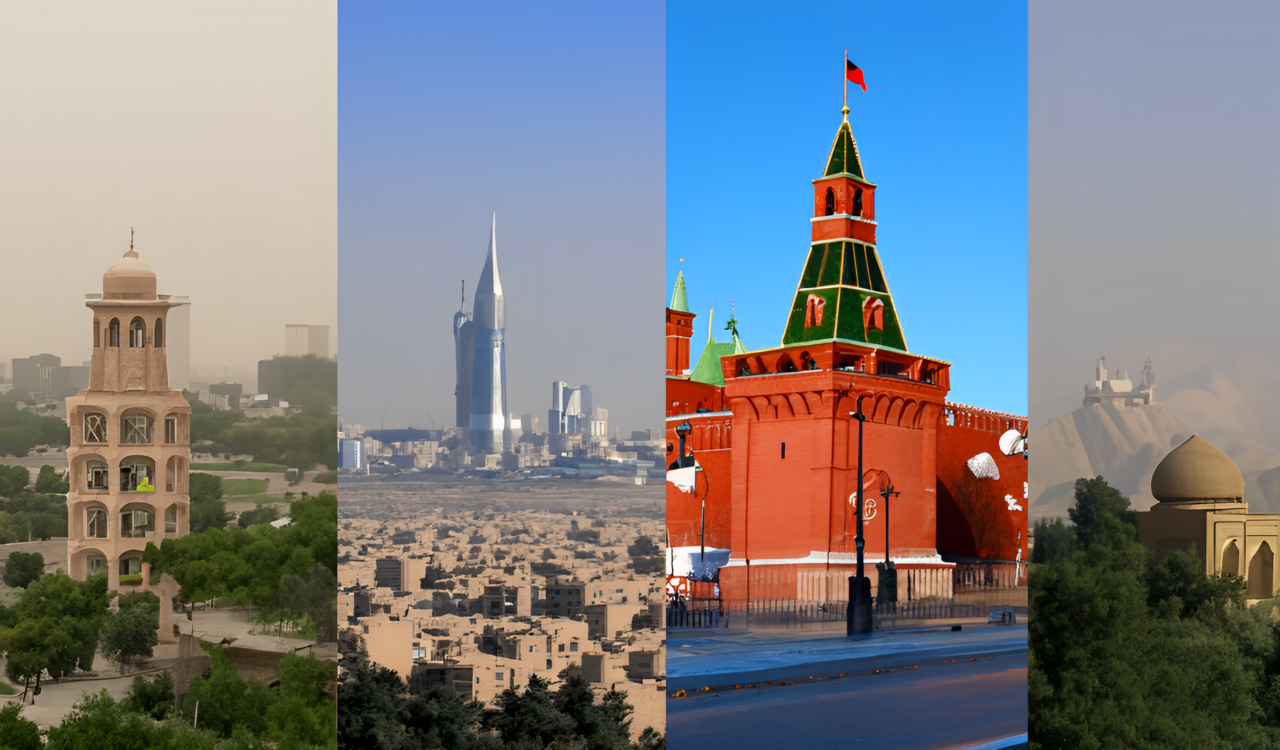
Pakistan has allowed barter trade with Russia and its neighboring countries Iran and Afghanistan. Pakistan’s Ministry of Commerce through a notification has allowed the government companies as well as the private sector to import and export products with the above-mentioned three countries.
The development of barter trade by Pakistan with the three countries has come at a time when Pakistan is facing dreadful and drastic economic problems. Pakistan is suffering from a trade deficit due to the higher volume of imports than exports. This trade deficit is causing an imbalance of payments due to the shortage of dollars (USD) in the country.
Although Iran is a neighboring country of Pakistan, it is not among the top 20 exporting countries from Pakistan while it is ranked last among the top 20 importing countries. Afghanistan’s imports to Pakistan are negligible or almost zero. However, Afghanistan is also included in the top 20 countries that account for the bulk of Pakistan’s exports.
Russia is not included in this list, nor is the volume of Pakistan’s imports from Russia high. According to experts, Pakistan’s barter trade with Iran and Afghanistan has been going on informally for a long time, but its volume was not high and now it has been given a lawful status. Pakistan has legalized the barter trade system with Iran, Afghanistan, and Russia but the question is how it is different from the prevalent trade system.
What is Barter Trade?
“Barter trade is the direct exchange of goods and services without the use of money”, Mr. Usman Qadir, an economist at the Pakistan Institute of Development Economics, told the EAT News. According to him “Barter trade is relatively rare in modern economies, where financial transactions and specialized markets are the main means of trade. Barter can still take place in certain situations, especially in informal or underdeveloped economies where financial transactions are limited. Barter trade may also take place in special sectors or in the context of specific trade arrangements. This will benefit both the country and the government as Pakistan is short of foreign exchange which is needed for imports”. He said that foreign exchange reserves will be saved from goods in exchange for goods.
The chief executive of the Trade Development Authority of Pakistan, Mr. Zubair Motiwala, during the conversation, told the EAT News, “Barter trade is essentially the trade of goods for goods, in which no money is involved. For example, if you want to give rice, the next person will give you coal instead of paying money for the purchase of that rice, this method could be traced back centuries”. On the one hand, foreign exchange will be saved, while on the other hand, the exports of the country and the volume of trade will also boost, he added.
According to the notification issued by the Ministry of Finance of Pakistan, the importers and exporters on the active taxpayer list of the Federal Board of Revenue (FBR) will be eligible for this barter trade.
Importers will be allowed by the government to import fruits, dry fruits, vegetables, pulses, chilies, minerals, metals, coal, raw rubber items, hides, iron, and steel from Afghanistan.
The government has permitted to import of fruits, dry fruits, chili spices, minerals, metals, coal, crude oil, LNG, LPG, chemicals, fertilizers, plastics, rubber, iron, and steel along with some other goods from Iran.
As far as Russia is concerned, local importers are authorized to buy pulses, wheat, coal, crude oil, LNG, LPG, fertilizers, plastics, rubber, minerals, metals, textile industry machinery, iron, and steel.
Talking about the latest development of barter trade with Iran, Afghanistan, and Russia, economist Mr. Zubair Motiwala said “It used to happen on behalf of the common people on the borders of Iran and Afghanistan. They have been doing barter trade on a limited scale, but now it has been legalized by the government”. He said that it was being worked on for three years and now it has been finalized and legitimized. He told that earlier, the State Bank of Pakistan (PBS) had also established counters at Chaman and Torkham borders to monitor the transactions that were taking place, however, after barter trade, these counters are no longer needed as there is no Rupee (PKR) or Dollar (USD) transaction involved.
Renowned economist Mr. Usman Qadir while commenting on the current decision made by the government of Pakistan said, “The latest attempt for barter trade was made in the context of Pakistan-Iran bilateral trade in 2022, mainly agricultural products such as rice and orange from Pakistan and apples from Iran were being traded”.
Sajid Amin, deputy director of the Sustainable Development Policy Institute, told EAT News in a telephonic conversation, “Pakistan could benefit from barter trade without increasing demand for dollars, particularly from oil and energy imports from Russia and Iran. Barter trade opportunity is important because of the dollar shortage faced by the countries. Although it cannot solve currency smuggling, especially on the Afghanistan border, it can discourage the smuggling of goods such as diesel from Iran and Afghanistan, which is hurting the economy”.
According to the declaration Ministry of Commerce, state-owned and private enterprises will be able to trade goods in exchange for goods (Barter System), but it was declared necessary for private enterprises to be on the FBR’s list of active taxpayers while the Pakistan Single Window System and import-export license will also be the basic conditions for importers and exporters. Application for trade in goods has to be made through FBR’s (Federal Board of Revenue) online portal. Verification from the Pakistani mission in the respective country has also been made mandatory for trade in goods.
June 1, 2023, a government order called the Business-to-Business (B2B) Barter Trade Mechanism 2023 lists the items that can be bartered. State-owned and privately owned enterprises will need approval to participate in the commercial process.
A large number are flocking to the Eat News for quality news every day, and readers in Taiwan, United States, United Kingdom, India, Japan, France, Pakistan, China, Malaysia and more, now support us financially.
In these chaotic, perilous times, an independent, truth-seeking news organisation like the Eat News is essential. We believe everyone deserves access to trustworthy information. That’s why we choose to keep our reporting open for all readers, regardless of where they live or what they can afford to pay.
The Eat News has no shareholders or billionaire owner, meaning our journalism is free from influence and vested interests – this makes us different. Our editorial independence and autonomy allows us to provide fearless investigations and analysis of those with political and commercial power. We can give a voice to the oppressed and neglected, and help bring about a brighter, fairer future.
If there were ever a time to join us, it is now. You have the power to support us through these volatile economic times and enable our journalism to reach more people, in all countries.
Every contribution, however big or small, makes a difference. Support the Eat News for better reporting.
Support the Eat News ➔


