

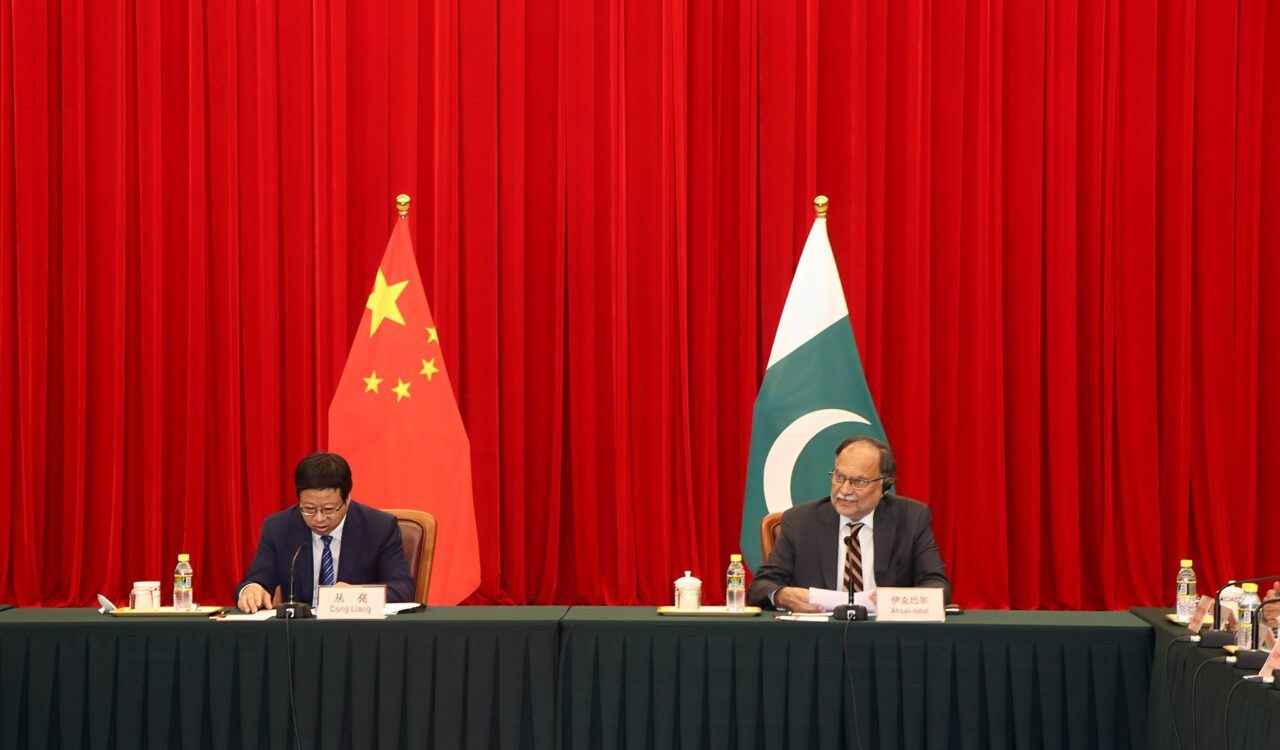
To commemorate the 10 years of China Pakistan Economic Corridor, Chinese President Xi Jinping’s Special Representative and Deputy Prime Minister He Lifeng visited Islamabad from 30th July to 01 August. Federal Ministers Mr. Ahsan Iqbal and Mr. Rana Sanaullah welcomed the Chinese Deputy Prime Minister and Chinese delegation including 4 ministers.
The Chinese Deputy Prime Minister attended the CPEC 10-year celebrations. In the ceremony, excellence awards were given to Chinese companies working on CPEC projects.
What is CPEC
Under the banner of the China-Pakistan Economic Corridor (CPEC), China is investing $ 62 billion in Pakistan, under which roads, agriculture, electricity, and water projects will be finalized. Former President Mr. Pervez Musharraf signed memorandums of understanding (MoUs) with China in 2006, in which around 50 projects were to be worked on.
CPEC is a very important part of China’s Belt and Road Initiative (BRI), which was formally launched in 2013 under the Muslim League-N government, while in April 2015, 51 (MoUs) worth $ 46 billion were signed between the two countries.
An accord was signed between the two neighbors in November 2017 for the long-term duration agreements, which covers the period from 2017 to 2030. The first phase of this agreement was to be completed by 2020. The time frame for the intermediate phase was set to 2025, while the third phase was to be completed by 2030.
Named as “One Plus Four”, the massive plan is referred to as ‘One’ CPEC and has four projects under it, including Gwadar port, energy, and communication systems, and upgrading industrial zones in Pakistan.
During the 10-year celebrations of the CPEC project, the two friendly neighboring countries signed six more memorandums of understanding to further strengthen bilateral cooperation and promote strong economic ties. To mark this historic occasion, the Government of Pakistan also released commemorative stamps, coins, and first-day covers.
The top leadership of the two countries also reviewed the completion, progress, and plans of various mega projects under the above-mentioned accord and reiterated their commitment to further development in different projects and to increase cooperation.
Ten years ago in 2013, after the Chinese President visited Pakistan, when the China-Pakistan Economic Corridor project was launched the country was going through the most critical moment in its history as at that time terrorism was out of control in Pakistan. The border tension with Afghanistan and India was at its peak, clouds of uncertainty were hanging over the country and every citizen was suffering from unrest and fear. No nation was willing to invest a single penny in Pakistan, on such an occasion, choosing Pakistan for a global mega project like the Belt and Road Initiative (BRI) is proof of the everlasting friendship of China with its bordering country Pakistan. Under CPEC, in the first phase, foreign investment of $ 25 billion came to Pakistan, which is a record in national history.
Prime Minister Mr. Shehbaz Sharif while speaking at the ceremony of giving awards to the leading Chinese banks and companies, said that CPEC is entering the second phase. China’s investment has changed the economic landscape of Pakistan, and Chinese companies and banks have played a magnificent role in the development of Pakistan.
According to the official statement issued by the PM office, a special event was held in Islamabad to mark the 10th anniversary of the China-Pakistan Economic Corridor (CPEC). Chinese President Xi Jinping’s special representative and Chinese Vice Premier Mr. He-Lefeng attended the event as chief guest.
Prime Minister Mr. Muhammad Shahbaz Sharif and the Chinese Deputy Prime Minister described the role of the China-Pakistan Economic Corridor project as important in the social, industrial, and economic development of Pakistan including the development and prosperity of the people of both countries.
The two leaders emphasized that the China-Pakistan Economic Corridor project has transformed Pakistan’s economic landscape by removing the fundamental constraints of development, planning, and eliminating power shortages. PM Shahbaz Sharif and Chinese Vice Premier He-Lifeng expressed satisfaction over the significant achievements of the CPEC project. The two leaders expressed a strong commitment to further development, planning, and cooperation based on the achievements of the last decade. The leadership of Pakistan and China also appreciated the efforts of Pakistani and Chinese experts, engineers, and workers for playing an outstanding role in the timely completion of all CPEC projects in Pakistan.
The Chinese Vice Premier congratulated the Pakistani nation on the completion of 10 years of the China-Pakistan Economic Corridor project. Senior ministers of China and Pakistan, top officials of both countries and corporate executives of leading Chinese companies operating in Pakistan attended the event.
The China-Pakistan Economic Corridor project has created more than 200,000 jobs in the country, added 8,000 MW of electricity to the national grid, completed the construction of 510 km of highways and 932 km of road network, and laid 820 km of optical fiber lines.
Under the second phase of the China-Pakistan Economic Corridor project, the two countries have expanded cooperation in new areas including rural rehabilitation, agricultural development, industrialization, green development, and science and technology.
Pakistan and China launched the China-Pakistan Economic Corridor project in 2013 after the visit of the Chinese President to Pakistan. Under this plan, the two countries have initiated and completed several projects in the past ten years in energy, communication infrastructure, port and airport development, digital connectivity, and some other sectors.
A large number are flocking to the Eat News for quality news every day, and readers in Taiwan, United States, United Kingdom, India, Japan, France, Pakistan, China, Malaysia and more, now support us financially.
In these chaotic, perilous times, an independent, truth-seeking news organisation like the Eat News is essential. We believe everyone deserves access to trustworthy information. That’s why we choose to keep our reporting open for all readers, regardless of where they live or what they can afford to pay.
The Eat News has no shareholders or billionaire owner, meaning our journalism is free from influence and vested interests – this makes us different. Our editorial independence and autonomy allows us to provide fearless investigations and analysis of those with political and commercial power. We can give a voice to the oppressed and neglected, and help bring about a brighter, fairer future.
If there were ever a time to join us, it is now. You have the power to support us through these volatile economic times and enable our journalism to reach more people, in all countries.
Every contribution, however big or small, makes a difference. Support the Eat News for better reporting.
Support the Eat News ➔


