

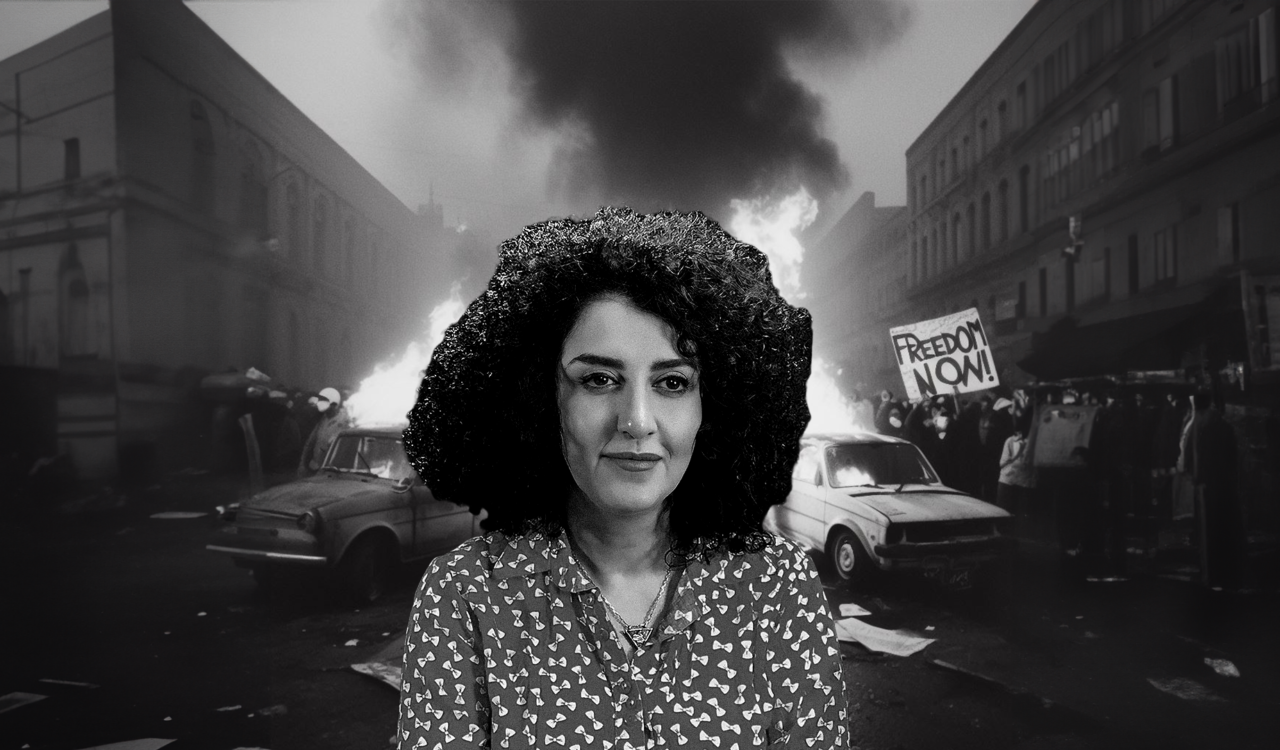
Women’s rights advocate Narges Mohammadi won the Nobel Peace Prize who has campaigned for three decades for women rights and against death penalty in Iran. According to the information, the award committee said the prize honored those behind recent unprecedented demonstrations prompting the Islamic Republics condemnation. Berit Reiss-Andersen, head of the Norwegian Nobel Committee while announcing the decision, said ‘The committee has decided to award Nobel Peace Prize 2023 to Narges Mohammadi for her fight against the oppression of women in Iran and her fight to promote human rights and freedom for all. Her brave struggle with tremendous personal cost. All together the regime has arrested her 13 times, convicted her 5 times and sentence her to a total of 31 years of prison and 154 lashes. Miss Mohammadi is still in prison as I speak.’
She is currently serving her sentence and is away from her family since. While her family is proud of her, she is accused of actions against national security and propaganda against the state. Iran is witnessing a massive protest since the death of Amini’s death, due to moral policing. The outrage sparked after the incident is still ongoing and could be seen in Iranian women standing against assaulting on the name of morals.
Indian women rights activist Sugandha R. applauded the women worldwide who are fighting against similar patriarchal issues in different societies. She said, ‘Narges Mohammadi is a woman to look up to when you are in this fight. And not only her, there are several women advocating for women rights in male dominating societies, we don’t know about. This is a moment to appreciate and applaud such women, that no efforts get waste instead motivates others to sense the responsibility of each other. It is sad that she was not present to receive it, but isn’t that shows that how she is still fighting for the people of her country with no fear.’
In august she was sentenced to an additional year in jail for her continued activism inside prison after she gave a media interview and a statement about sexual assaults in jail, quoted CNN. Indian activist Sugandha recalls similar incidents in India and how a woman has to struggle, outside and inside the family. ‘While Mohammadi is fighting for everybody, there are number of women fighting from their own family. I remember a case of India, where a teenage girl was abandoned by her family when she confronted that she was raped by her father’s brother. Instead of punishing the accused, her family decided to lock her up in her room, but she fled away. Whoever speaks against powerful, has to bear consequences, but this is the narrative that we need to change. And we have to do it for ourselves first, and then others’, she said.
Moral policing has emerged as a common act in middle east countries, especially in Iraq, Saudi Arabia, Afghanistan. World is witnessing, women led protests across the world, since the death of Mahsa Amini. Where India stands on this, activist Sugandha told EAT news. She said, ‘Moral policing is not legal or included in Indian law. But it is something that some police men practice anyways. When they start taking morals in their hand. Here, we use to see such incidents on specific occasions like celebrations on Valentine’s day. But now, environment has changed to an extent. However, there are other major issues in India women is battling with. Domestic abuse and sexual assaults, right to education etc.’
According to Sugandha, Iran’s protest hasn’t affected much India on political terms or on ground. ‘I haven’t seen a single political leader talking about Iran’s issue in parliament or on public forums. On ground, not many people know the exact story what happened, and especially women are not aware about the case. Due to less exposure of external information, women in India are deprived of such significant information’, she said. If women will not be aware of their rights and how the community across the world is fighting for each other, where the courage will come from, she believes.
Social media has played a relevant role in the time, when protests have become common. Today a state issue has not remained within the boundaries but concerns other nations, human rights organization, and international relations, only when it reaches masses. And twitter, Facebook, Instagram has become a medium to spread the news. ‘As soon as it reaches people, state starts acting. Because whatever crowd decides, it bothers administration. And when it is a sensitive issue, it requires heavy forces. But through this platform, I want to pass a message that never stop fighting for what is right. Even if you are alone, advocate for the sake of peaceful future. You will be joined by people, sooner or later’, said Indian activist Sugandha R.
A large number are flocking to the Eat News for quality news every day, and readers in Taiwan, United States, United Kingdom, India, Japan, France, Pakistan, China, Malaysia and more, now support us financially.
In these chaotic, perilous times, an independent, truth-seeking news organisation like the Eat News is essential. We believe everyone deserves access to trustworthy information. That’s why we choose to keep our reporting open for all readers, regardless of where they live or what they can afford to pay.
The Eat News has no shareholders or billionaire owner, meaning our journalism is free from influence and vested interests – this makes us different. Our editorial independence and autonomy allows us to provide fearless investigations and analysis of those with political and commercial power. We can give a voice to the oppressed and neglected, and help bring about a brighter, fairer future.
If there were ever a time to join us, it is now. You have the power to support us through these volatile economic times and enable our journalism to reach more people, in all countries.
Every contribution, however big or small, makes a difference. Support the Eat News for better reporting.
Support the Eat News ➔


