

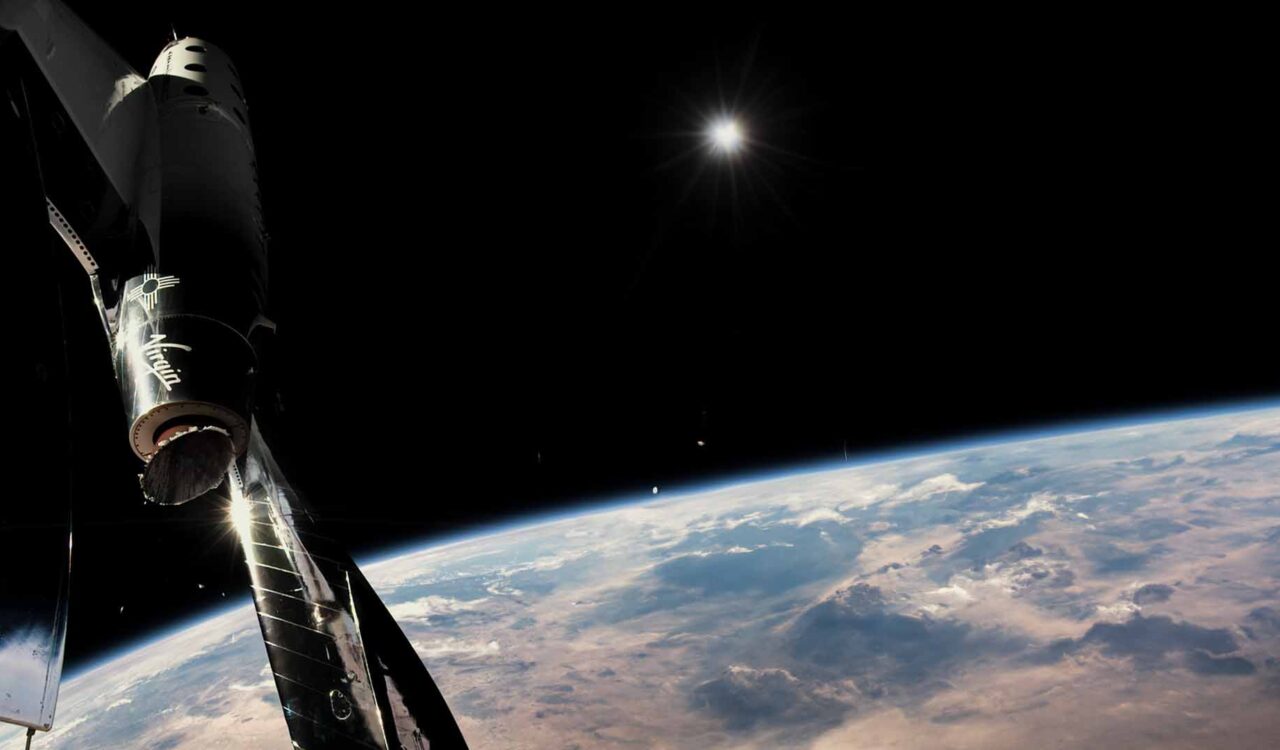
Virgin Galactic recently announced they’re cutting nearly a fifth of their staff, a sobering dose of reality in these uncertain times. Could this be a sign that space tourism dreams are slipping further into the future, or could it help Virgin Galactic streamline its operations to start launching paying customers sooner?
The layoffs hit Virgin Galactic’s manufacturing hub in Mojave, California, particularly hard. Nearly 80 of the terminated employees were based at the Mojave Air and Space Port, representing about 18% of the total workforce there.
Many of these workers were involved in building Virgin Galactic’s current spacecraft, VSS Unity, and the carrier plane that transports it to high altitude, VMS Eve. Cost reduction was necessary since the company was refocusing on the next generation of Delta-class spaceships.
The layoffs might be an indication of higher output and a way for Virgin Galactic to save costs while building the Delta-class spacecraft. Unlike the company’s VSS Unity craft, which only flies once a month, the Delta-class spaceships are intended to fly eight times per month. With more seats than their predecessor, the Delta class ships are predicted to generate roughly a million in revenue each month once flights begin.
Although it is difficult to dismiss nearly 200 employees, Virgin Galactic claims that it is imperative to accelerate the building of its Delta-class spacecraft. With the new spaceships, Virgin Galactic will be able to increase space tourism flights and begin making more money.
Maintaining the current VSS Unity flights while simultaneously funding the development of the Delta-class ships has proven costly. The layoffs are projected to result in cost reductions of up to a million annually, which could offer financial respite following years of expensive spaceship development that produced no revenue.
Virgin Galactic’s space planes are designed to take paying customers on thrill rides to suborbital space, with tickets selling for $450,000 a seat. In the long run, the company wants to fly 400 space tourism missions annually. Virgin Galactic needs its new spaceships ready to fly and fast to meet that ambitious goal and turn a profit.
The Delta-class spaceships will allow Virgin Galactic to ramp up the frequency of spaceflights for space tourists. Instead of waiting for weeks or months between launches, the eightfold flight increase will mean aspiring astronauts may only have to wait days or weeks to experience the thrill of space travel.
While painful in the short term, the reorganization could benefit Virgin Galactic in the long run.
Eve, the wife of Roman Philip, a former Virgin Galactic employee, told Eat News about her husband’s ordeal. Given the inherent risks, she acknowledged the challenges of his job but highlighted that this didn’t diminish the value of his engineering skills to the company. As a family, they benefited immensely as the pay was handsome, yet Eve noted that they now needed to explore new opportunities. Despite the uncertainties, she expressed gratitude for the support they received while acknowledging the necessity of seeking “greener pastures” in the next chapter of their journey.
Richard Branson has never been one to give up easily. Despite the major setback of laying off nearly 20% of Virgin Galactic’s workforce, Branson remains fully committed to making space tourism a reality.
The intention behind Branson’s 2004 founding of Virgin Galactic was to provide suborbital spaceflights to commercial clients. The company has advanced significantly with over 15 years of research, development, and testing.
To realize Branson’s goal of regular space tourism flights, the new Delta-class spaceships presently under development are essential. With their higher launch cadence capabilities, these next-generation vehicles will make space travel accessible to hundreds of private astronauts annually. While the road to get here has been long, Branson remains as passionate as ever. His optimism and determination have kept the dream of Virgin Galactic alive through enormous challenges.
Even though the immediate consequences might be severe, the cost-cutting steps might help Virgin Galactic survive until space travel formally begins. In the race to launch suborbital space tourism, Virgin Galactic faces competition from companies like Blue Origin, and some analysts claim that this is evident from the staff reductions. However, others point out that developing innovative technologies always requires trial and error, and funding ebbs and flows.
Virgin Galactic is pushing ahead full throttle to get their futuristic Delta spaceships up and running to transform space travel. The final frontier will open, and space tourism will become a reality thanks to Branson’s perseverance and lifelong goal of making space more accessible. Despite the difficult layoffs, the future remains bright for Virgin Galactic. Branson’s vision and commitment to this goal show no sign of slowing down.
In a bid to reduce its workforce by 18%, Virgin Galactic’s future of space tourism appears to hang in the balance. The harsh reality of staff cuts reflects the challenging landscape businesses, even those in space exploration, go through. However, optimism persists as questions arise about the potential for this restructuring to expedite Virgin Galactic’s journey towards making space travel a reality for paying customers.
A large number are flocking to the Eat News for quality news every day, and readers in Taiwan, United States, United Kingdom, India, Japan, France, Pakistan, China, Malaysia and more, now support us financially.
In these chaotic, perilous times, an independent, truth-seeking news organisation like the Eat News is essential. We believe everyone deserves access to trustworthy information. That’s why we choose to keep our reporting open for all readers, regardless of where they live or what they can afford to pay.
The Eat News has no shareholders or billionaire owner, meaning our journalism is free from influence and vested interests – this makes us different. Our editorial independence and autonomy allows us to provide fearless investigations and analysis of those with political and commercial power. We can give a voice to the oppressed and neglected, and help bring about a brighter, fairer future.
If there were ever a time to join us, it is now. You have the power to support us through these volatile economic times and enable our journalism to reach more people, in all countries.
Every contribution, however big or small, makes a difference. Support the Eat News for better reporting.
Support the Eat News ➔


