

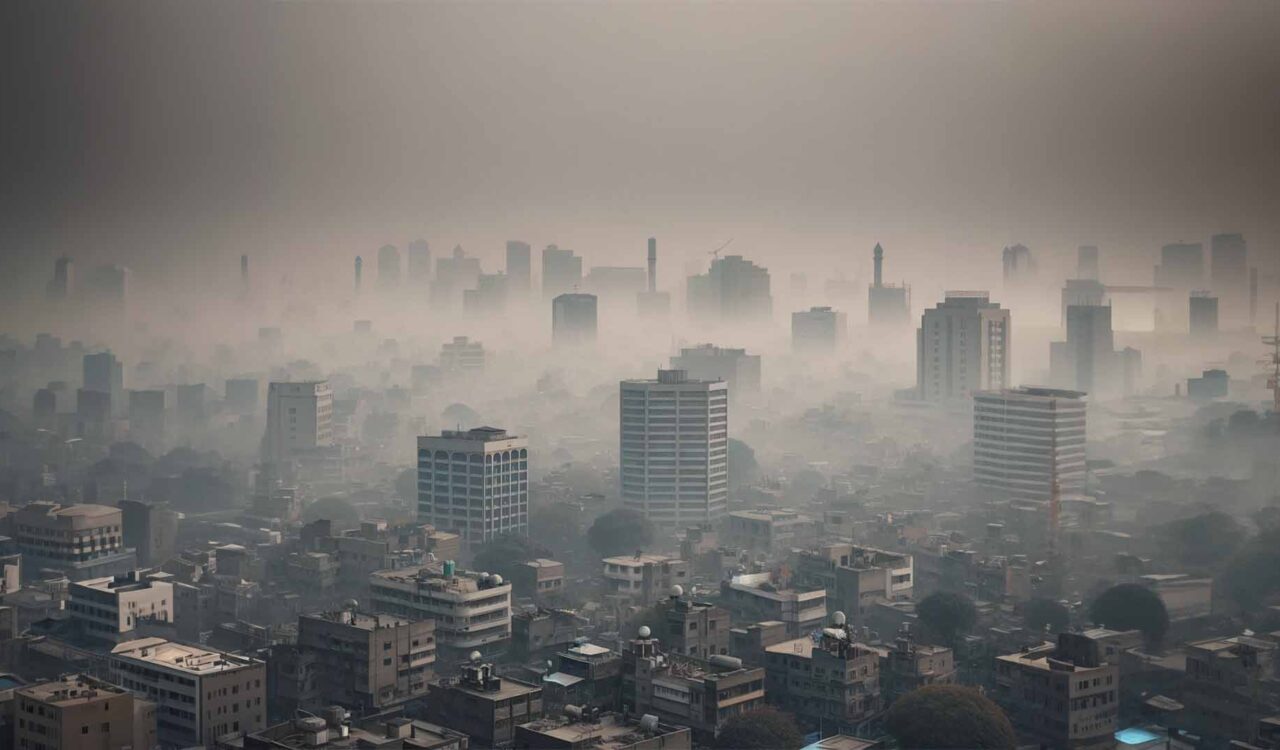
Even before the cold weather began, Lahore was covered in smog, making it the most polluted city in the world with really bad air quality in the last couple of weeks.
Once known as the “city of gardens”, Lahore now has really bad air. Last week, the air quality was super bad, with a score of 510 on the AQI (Air Quality Index) US scale, which measures how clean or dirty the air is. The air quality in Lahore is the worst in the world right now, with a score of 376, followed by Delhi at 333. Just so you know, the air is considered good if the AQI US is up to 50. But once it goes beyond 100, it’s not good, especially for people who are sensitive to bad air, and if it goes beyond 150, it’s bad for everyone.
The Director General (DG) of the Environment Department, Zaheer Abbas Malik, while speaking to EAT news mentioned that they are taking strong action against certain types of plants and kilns. They checked 233 brick kilns in Lahore and 12,056 in other cities, giving out 2,213 notices for rule violations. They closed down 1,124 brick kilns and even destroyed some that didn’t follow the right technology. The violators were fined a total of PKR 91.8 million.
The Water and Sanitation Agency (WASA) Lahore is using mist-queen machines to spray water on the main roads of the city. This is to reduce the things that cause smog. “We made two mist-queen machines ourselves. Additionally, we have 20 water tankers spreading water and 30 jetters cleaning the roads. This whole team is focusing on major roads and different areas,” an official source in WASA said.
He added, “Sprinkling water is a big help in getting rid of dust pollution, and mist machines and other equipment are crucial for making it happen”. The official mentioned that controlling smog wasn’t exactly WASA’s job, but they were doing it to support the government’s efforts in dealing with the health risks. He also mentioned that they are working on making more mist machines. These machines spray water from all sides—right, left, front, and top.
Lahore, the main city in the eastern province of Punjab next to India, has about 15 million people. This year, it is making news because the air there is really bad. Lots of folks are getting sick with allergies or breathing problems because of the poor air quality.
This week, Lahore was named the city with the worst air quality for three days in a row by AirVisual, an international air quality monitoring service. They use a scale called the Air Quality Index (AQI) based on calculations from the U.S. Environmental Protection Agency. In these three days, Lahore’s AQI was 406, 372, and 422, which is a high negative. Only after some rain on Friday did it drop to 108. By Friday, London had a reading of 25, Istanbul had 61, and Mexico City had 88, much lower than Lahore’s numbers.
According to AirVisual, the amount of tiny particles in Lahore’s air reached 450 this week. That is 30 times more than what the World Health Organization says is safe for daily exposure on average, and it’s considered dangerous.
Whether the air was really dangerous or just not so great, the Punjab government decided to give everyone a break. They declared a public holiday on Friday, making it a four-day weekend that included the already scheduled Thursday off (9–12- Nov 2023).
To tackle the environmental issues, the government took some serious measures. Public places, restaurants, and markets were closed down, and the government enforced a lockdown, urging people to stay indoors. The interim health minister, Dr. Javed Akram, explained that the extra holiday was a one-time move to reduce traffic and, in turn, decrease pollution.
He pointed fingers at farmers in both Pakistan and India who burn crop stubble after harvesting rice to make way for wheat crops. Dr. Akram emphasized that stubble burning, especially in India, poses a significant challenge, and there’s limited control over it.
Mohammad Farooq Alam from the Punjab government’s Environmental Protection Agency mentioned that India burns about five times more crop stubble than Pakistan. Despite local efforts like fines on farmers and exploring alternative ways to manage agricultural waste, external factors like wind direction make it difficult to control the impact.
It’s not just the farmers; the deputy director of the Punjab government’s Environmental Protection Agency, Mohammad Farooq Alam, admitted that vehicle emissions play a big role in harming the environment. He highlighted that atmospheric conditions between October and late November contribute to trapping pollutants near the ground, making the smog even worse. So, it’s a combination of factors, including vehicular pollution and weather conditions, that are degrading the environment in the region.
Sara Hayat, a climate change lawyer in Pakistan, supported the government’s decision to implement a lockdown but pointed out a challenge. She mentioned that the lack of effective enforcement comes from inadequate awareness and institutional policies. According to her, the government’s actions are more of a short-term solution without proper prior notice, and for it to be truly effective, there need to be comprehensive, long-term policies in place.
The shutdown in Lahore is not just an inconvenience; it is adding more disruption to the daily lives of its citizens, who are already dealing with the harmful air they can’t avoid breathing. Mehtab Khan, a business owner in Shahpur, a densely populated area of Lahore, shared that the government’s decision to close markets has resulted in significant financial losses for his printing business, amounting to hundreds of thousands of rupees. He expressed the dilemma of being unable to go to the market or have staff in the office, leading to business losses. However, staying at home isn’t a solution either, as the poor air quality is affecting his health. It’s a tough situation for the people of Lahore.
Hajra, a ninth-grade student, shared her observation on the annual smog season, saying that every year, as winter begins, smog becomes a periodic issue. The government implements some measures, and when the smog season ends, things go back to normal.
Her mother, Mehreen Khan, an artist, added that although last year’s weather conditions made the smog somewhat less severe than usual, this year it’s much more intense. Ms. Khan emphasized that the Air Quality Index (AQI) readings are once again very high, and there’s no relief due to a lack of wind. She also pointed out that certain government road projects, which were not well-thought-out, are contributing to the pollution problem. It seems like a frustrating situation for the residents of Lahore, dealing with a repetitive issue that intensifies each year.
Being at home with her 15-year-old daughter during the smog season in Lahore, Ms. Khan considers herself fortunate to have an air purifier that helps with the physical effects of the poor air quality, though it doesn’t alleviate the mental toll. Despite stocking up on face masks and ensuring all windows are closed, the smog season takes a draining and depressing toll on them. She mentioned that spending autumn in Lahore is no longer something they look forward to.
Hajra, Khan’s daughter, shared her perspective, highlighting the disruption caused by the smog season. Having experienced online schooling during the two-year COVID-19 pandemic, going to school physically is crucial to her. However, with the school closed due to the smog, it’s affecting her routine, especially with exams approaching. Even outdoor activities like playing tennis are limited due to the worsening smog in the evenings. Hajra said that some of her classmates are dealing with allergies and asthma, further restricting their opportunities to go out. The smog season is not just an environmental concern but has a significant impact on the daily lives and well-being of the residents in Lahore.
‘If you haven’t seen Lahore, you haven’t even lived’ goes the popular saying. Unluckily, the persistent smog in winter has made it increasingly difficult to visually experience Lahore. However, the issue extends beyond Lahore, it’s not confined to the winter season, and it’s not just affecting people’s ability to see clearly. Poor air quality is impacting various aspects beyond visibility.
A large number are flocking to the Eat News for quality news every day, and readers in Taiwan, United States, United Kingdom, India, Japan, France, Pakistan, China, Malaysia and more, now support us financially.
In these chaotic, perilous times, an independent, truth-seeking news organisation like the Eat News is essential. We believe everyone deserves access to trustworthy information. That’s why we choose to keep our reporting open for all readers, regardless of where they live or what they can afford to pay.
The Eat News has no shareholders or billionaire owner, meaning our journalism is free from influence and vested interests – this makes us different. Our editorial independence and autonomy allows us to provide fearless investigations and analysis of those with political and commercial power. We can give a voice to the oppressed and neglected, and help bring about a brighter, fairer future.
If there were ever a time to join us, it is now. You have the power to support us through these volatile economic times and enable our journalism to reach more people, in all countries.
Every contribution, however big or small, makes a difference. Support the Eat News for better reporting.
Support the Eat News ➔


