

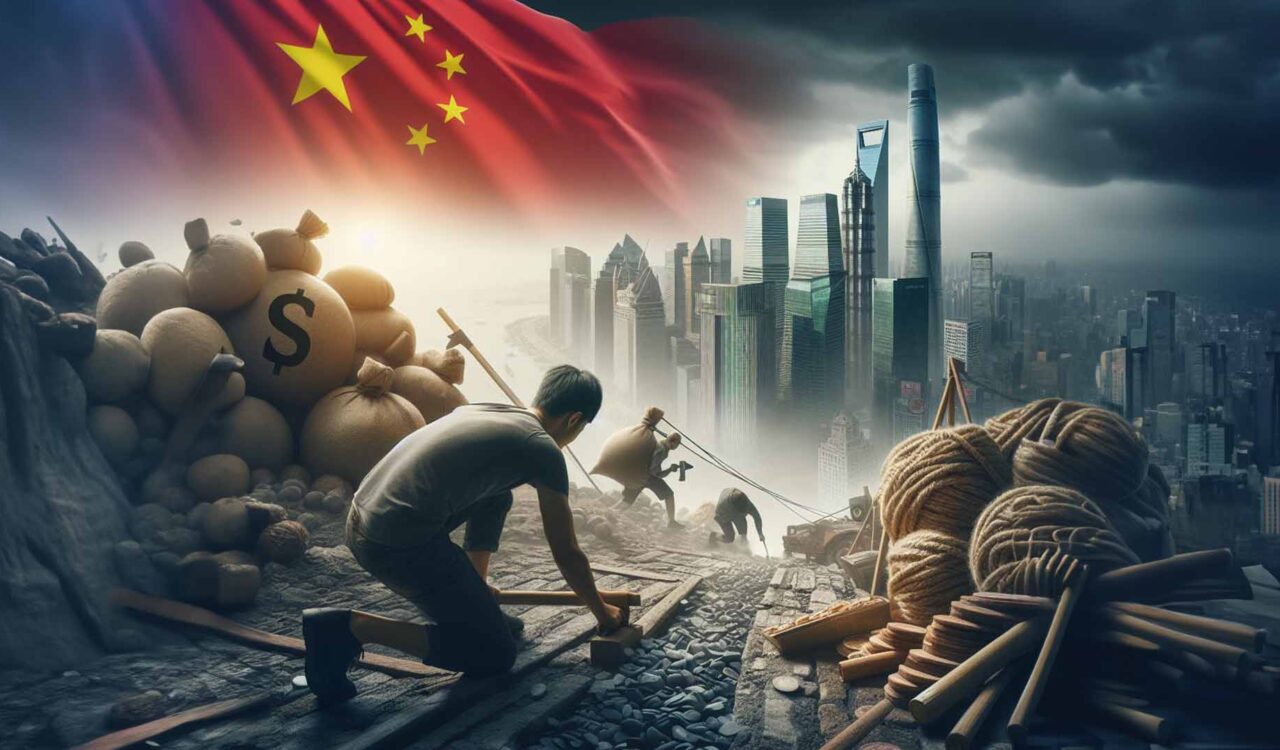
While various central banks across the globe continuously battle inflation, China is in a whole different zone, experiencing a steep fall in prices.
According to one China National Bureau of Statistics Saturday analysis, the Consumer Price Index (CPI) saw a 0.5% drop in November annually, the biggest fall since the COVID-19 pandemic three years ago.
The drop symbolizes an increase in the deflation rate from October, when the CPI fell 0.2% from the previous year. As a result, Beijing had to step in promptly to boost demand and prevent a downward spiral of prices.
The data comes in days after Chinese lawmakers resorted to strengthening fiscal and monetary support for the country in a bid to boost the world’s second-largest economy. Typically, China has been struggling with the real estate crisis, high youth unemployment and receding consumer confidence.
Ostensibly, China has been fighting weak prices for the better part of the year as a result of the property market slump and coherent weak spending. Deflation is bad for any economy as companies and consumers may intentionally put off purchases or investments, for that matter, hoping that prices may continue to fall further. In turn, this could slow down the economy’s growth and lead to a vicious cycle.
Consumer inflation in China began subsiding in February this year and turned negative in July for the first time in two years. It was on a positive trajectory in August but fell below zero again in October.
China’s deflation predicament is worsening, hit by a triple blow from rising domestic food prices, corrections in international oil prices, and sluggish domestic demand, according to analysts at Citi in a report released on Sunday. They noted that the indications of price softness are now extending beyond goods to encompass various services.
Food prices constituted the lion’s share of the CPI, 4.2% down from November last year. Pork prices, for instance, plummeted by 31.8%. Fuel prices declined after international oil prices hit their lowest levels in November. On the other hand, services inflation also slowed. It was at 1% last year compared to just a 1.2% increase in October. Overall, the Producer Price Index (PPI), usually driven by commodity prices and raw materials, dropped 3% in November for 14 months.
More Stimulus Needed
The escalating deflationary challenges in China have raised more concerns about the country’s economic recovery, prompting a call for swift policy action. Analysts from Citi said, “There is no time for policy hesitation to prevent a vicious loop between deflation, confidence, and activities.”
To address this, Pan Gongsheng, the governor of the People’s Bank of China, emphasized the commitment to maintaining an “accommodative” monetary policy in remarks in Hong Kong late last month. He was optimistic that consumer prices are going to rise in the coming months.
In an exclusive with Eat News, Lee, a Chinese national currently residing in the UK, opened up about the challenges faced by his apparel company. “Running my clothe company has become more tricky owing to the constant deflationary trends. Our spending patterns have been greatly affected, and we find ourselves in a worse position compared to the same time last year. We hope the government takes the necessary steps to solve this,” he said.
Last Friday was significant for China’s economic landscape as top officials convened for an urgent Politburo meeting. To demonstrate their commitment to bolstering the economy, the officials pledged to intensify efforts to expand domestic demand and catalyze consumer spending. This development is coupled with the imminent annual Central Economic Work Conference (CEWC) scheduled later this month.
Typically, the Politburo meeting and the subsequent CEWC are important in articulating the comprehensive economic policy framework for the year ahead. Investors keenly anticipate the insights and specifics that will be unveiled during the CEWC, expecting it to give direction on the economic strategies and initiatives in the coming months.
Citi analysts closely monitor the unfolding events and anticipate a comprehensive unveiling of economic policies during CEWC, particularly the possibility of “imminent” adjustments to key financial measures like the reserve requirement ratio (RRR) and interest rates.
The RRR dictates the percentage of funds banks must keep in reserve. Basically, anticipation of potential cuts to the RRR is widespread among market participants. A move that would inject liquidity into the financial system and, hence, create a more friendly environment for lending and numerous economic activities. Further, interest rate adjustments are also ongoing, with expectations of a subtle approach to stimulating economic growth and, at the same time, maintaining financial stability.
As global markets remain on the lookout for the outcomes of these mitigations, the Politburo meeting and the subsequent CEWC are poised to resonate across financial landscapes, influencing investor sentiment and shaping economic expectations within China and around the world.
A large number are flocking to the Eat News for quality news every day, and readers in Taiwan, United States, United Kingdom, India, Japan, France, Pakistan, China, Malaysia and more, now support us financially.
In these chaotic, perilous times, an independent, truth-seeking news organisation like the Eat News is essential. We believe everyone deserves access to trustworthy information. That’s why we choose to keep our reporting open for all readers, regardless of where they live or what they can afford to pay.
The Eat News has no shareholders or billionaire owner, meaning our journalism is free from influence and vested interests – this makes us different. Our editorial independence and autonomy allows us to provide fearless investigations and analysis of those with political and commercial power. We can give a voice to the oppressed and neglected, and help bring about a brighter, fairer future.
If there were ever a time to join us, it is now. You have the power to support us through these volatile economic times and enable our journalism to reach more people, in all countries.
Every contribution, however big or small, makes a difference. Support the Eat News for better reporting.
Support the Eat News ➔


