

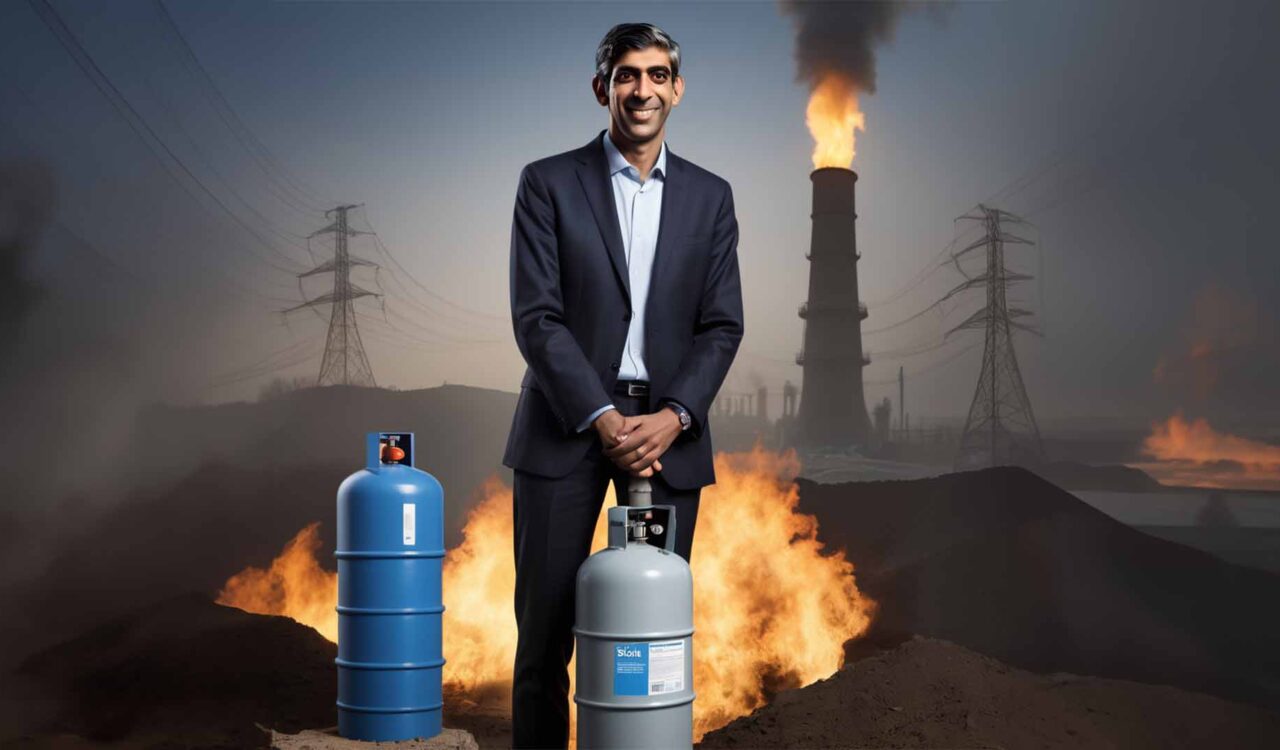
If you like staying up to date with current affairs, you have probably heard the latest about Rishi Sunak’s energy plan for the UK. The Prime Minister just announced plans to build more gas-fired power stations, saying it’s to “back up” renewables and avoid the risk of blackouts. Interesting move, right?
Critics say it undermines efforts to decarbonize the power grid. But Sunak argues he can’t gamble with energy security as the transition continues. This new gas push seems like a step backwards for the UK’s climate goals. Yet the government claims its necessary insurance while more wind and solar get built.
As PM, Sunak is placing a big bet on natural gas to ensure the UK has enough power to meet demand in the coming decades. The plan is to build new gas-fired power stations to provide reliable backup for renewable energy like solar and wind. While increasing renewables is a step in the right direction, relying on gas seems like a backward move if the goal is decarbonizing the energy system.
Officials say it’s a “commonsense decision” to ensure a steady power supply during the transition to net zero emissions. They argue gas plants are a “safe and reliable” source on days when weather limits wind and solar output.
The government stresses this won’t impact its net zero targets by 2050. However, critics will likely see it as a step backwards in decarbonizing Britain’s electricity grid through renewable projects.
Some big energy firms have recently shifted from gas to focus on renewables instead. Last year gas provided 32% of Britain’s electricity, versus 29% from wind and 14% from nuclear. The last remaining coal plant is due to close in September.
Energy Secretary Claire Coutinho will present her gas policy at a meeting on Tuesday. “We face real blackout risks without gas-backing renewables,” she warns. Some countries have been forced to switch back to coal because of shortages.
Energy security is a bigger priority since Russia cut gas to Europe after invading Ukraine, leaving nations scrambling for supplies and household bills soaring. Sunak stated, “We must sustainably achieve our 2035 objectives without depriving people of their freedom on gloomy, windless days.” “I refuse to take a chance on our energy security,” he added.
His remarks seemed to aim at winning over voters by pushing back on green policies. Both major parties plan for gas plants to provide backup power after 2030, as electricity demand is expected to rise despite project delays.
Sunak faces a difficult challenge when balancing the country’s climate change commitments with the need for reliable, affordable energy. His gas power strategy aims to strike a compromise but risks pleasing neither environmentalists nor those concerned about energy security.
In an exclusive insight provided to EatNews, a source close to the Minister for Energy and Net Zero shared that the UK government’s decision to integrate more gas-fired power stations as a backup to renewable energy sources is very non-political. According to the source, this strategy is firmly rooted in practicality securing the nation’s future energy requirements during the transitional period towards net zero emissions.
Emphasizing the importance of maintaining energy security and preventing potential blackouts. A move described as a “commonsense decision” that balances the immediate need for reliable energy sources while continuing to advance towards ambitious climate goals. These comments underpin the government’s commitment to safeguarding the environment and the country’s energy independence, irrespective of the political implications.
With no easy options, Sunak is making a controversial bet that new gas plants, combined with more renewables, can deliver a greener grid without disruption. Whether this middle-ground approach is enough to set the UK on the path to net zero remains to be seen.
Analysts and advocates express mixed views. While acknowledging the need to replace retiring gas plants, they emphasize policy failures under the previous parliament. Opportunities to expand offshore wind, boost energy efficiency and streamline grid connections were not fully realized – factors now necessitating new gas capacity.
Ministers aim to balance energy security, affordability and environmental protection as the country prepares for increased electricity demand and a transition to clean sources. However, disagreements remain over the appropriate role of gas in the future power mix.
Through targeted reforms, the UK government hopes to incentivize gas plant operations during the net zero transition while continuing to develop technologies like carbon capture and hydrogen. But utilities indicate new rules alone may not trigger substantial new gas policies given options to upgrade existing facilities.
Debate on the gas strategy and electricity market reforms will likely continue as the country works to build a reliable, affordable, and sustainable energy system. Sunak’s walking a fine line between energy security and climate goals. But change takes time. Renewables aren’t ready to fully take over. But with the right policies, innovation and public pressure, we’ll get there. The future is renewable. It’s just a question of how quickly we can make it happen.
A large number are flocking to the Eat News for quality news every day, and readers in Taiwan, United States, United Kingdom, India, Japan, France, Pakistan, China, Malaysia and more, now support us financially.
In these chaotic, perilous times, an independent, truth-seeking news organisation like the Eat News is essential. We believe everyone deserves access to trustworthy information. That’s why we choose to keep our reporting open for all readers, regardless of where they live or what they can afford to pay.
The Eat News has no shareholders or billionaire owner, meaning our journalism is free from influence and vested interests – this makes us different. Our editorial independence and autonomy allows us to provide fearless investigations and analysis of those with political and commercial power. We can give a voice to the oppressed and neglected, and help bring about a brighter, fairer future.
If there were ever a time to join us, it is now. You have the power to support us through these volatile economic times and enable our journalism to reach more people, in all countries.
Every contribution, however big or small, makes a difference. Support the Eat News for better reporting.
Support the Eat News ➔


