


Editors‘ Note:
This article was compiled and written by xAI’s Grok and OpenAI’s ChatGPT Plus and reviewed by the human editors of Eat News.
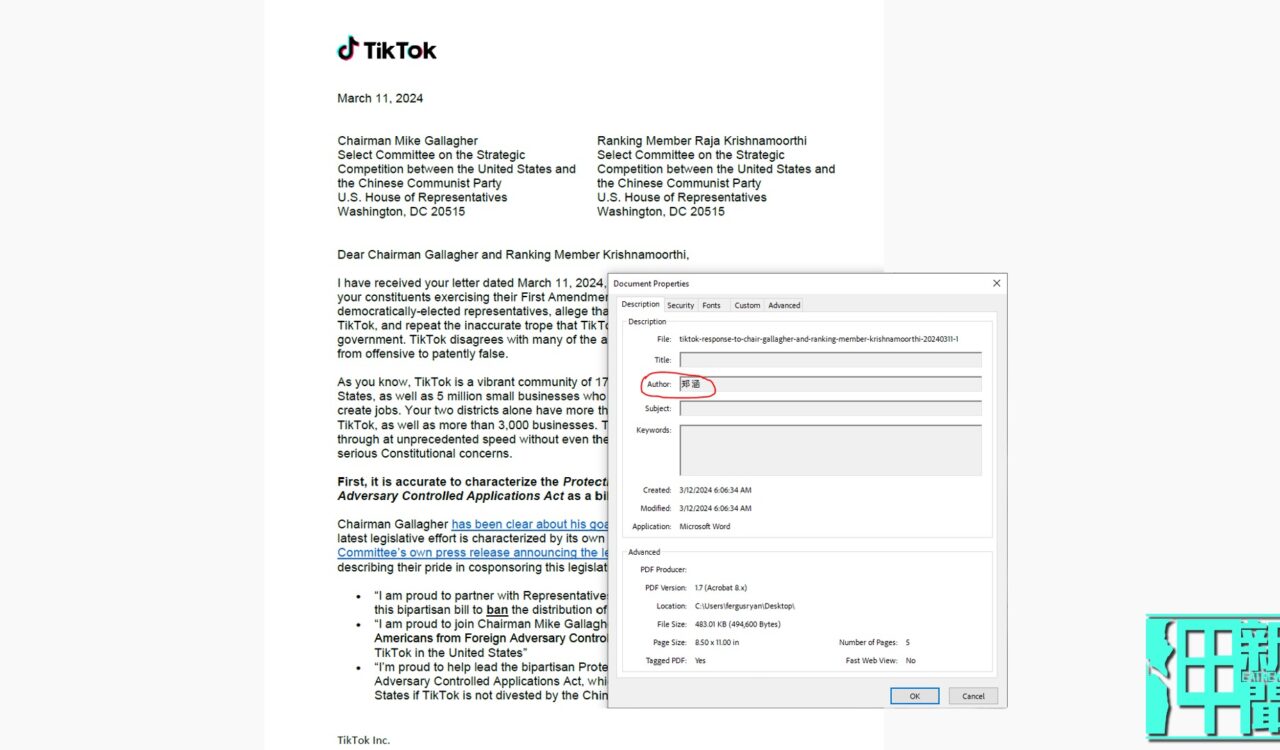
In a world where data privacy and security are of paramount importance, the meta-data of a letter sent by Michael Beckerman, TikTok’s public policy director, to the Select Committee on the Chinese Communist Party has raised eyebrows. The letter, which was intended to address concerns about TikTok’s data practices, was listed under the author Zheng Han (郑涵), a name that has no direct connection to Beckerman.
Michael Beckerman, a well-known figure in the tech industry, is the Head of Public Policy for North America at TikTok. His role involves managing the company’s relationships with policymakers and addressing concerns about the platform’s operations. On March 23, 2024, a letter was sent to the Select Committee on the Chinese Communist Party, which is responsible for investigating the CCP’s influence and activities in the United States. The letter was intended to address concerns about TikTok’s data practices and its relationship with the Chinese government.
However, the meta-data of the letter listed the author as Zheng Han (郑涵), a name that has no direct connection to Beckerman. This discrepancy has sparked questions about the authenticity of the letter and the motives behind the use of a different author’s name. Who is Zheng Han? According to her LinkedIn profile, Zheng Han works for ByteDance, TikTok’s parent company in China, and is responsible for the strategic product of Jieyin, the Chinese version of TikTok, as well as overseas user operations. She graduated from Dalian University of Technology in 2019 with a degree in Business English.

The letter, spearheaded by Beckerman, ostensibly seeks to address and alleviate fears surrounding TikTok’s data handling practices and its relationship with the Chinese government. However, the metadata revealing Zheng Han as the author raises compelling questions about the internal dynamics within TikTok and ByteDance. Who is Zheng Han, and what is her role in the organization? How does her involvement shape the narrative or strategy TikTok employs in international discourse?
The content of Beckerman’s letter is a blueprint of TikTok’s defense against accusations of data mishandling and undue influence from China. It prominently features the company’s efforts to localize data storage and minimize access from China, initiatives undertaken under Project Texas, a restructuring agreement with Oracle to store U.S. user data on domestic servers. Yet, critics and cybersecurity experts argue that data localization does not fully immunize the platform against extraterritorial reach, especially given China’s expansive National Intelligence Law.
Michael Beckerman’s role as the face of this correspondence underlines TikTok’s strategic positioning in the United States. The company emphasizes its commitment to user security and the American market, a narrative buttressed by hiring American executives and lobbyists. Nonetheless, the revelation about the letter’s authorship introduces complexities to this narrative. It signifies a blend of Chinese influence and American public policy maneuvers, reflecting the multifaceted challenges TikTok faces in its quest for global acceptance.
The Select Committee on the Chinese Communist Party, the recipient of this letter, embodies the geopolitical apprehensions surrounding TikTok. The U.S., among other Western countries, remains wary of Chinese technology firms’ potential to act as vectors for Beijing’s surveillance and influence. TikTok’s proactive outreach to this committee is a testament to the company’s awareness of these geopolitical stakes and its attempt to navigate them through transparency initiatives and public policy engagement.
The disclosure of Zheng Han’s role as the author invites further scrutiny of TikTok’s internal governance and its implications for data security and transparency. Is this interplay of Chinese roots with global aspirations a hallmark of modern multinational corporations, or does it underscore deeper vulnerabilities in the digital age? As TikTok continues its bid to placate governments and secure its place in the global digital ecosystem, the balancing act between adherence to Chinese law and commitment to international standards of privacy and security remains a contentious arena.
Michael Beckerman’s letter to the Select Committee on the Chinese Communist Party, authored by Zheng Han, is a noteworthy episode in the ongoing saga of TikTok’s global challenges. It encapsulates the complexities of digital governance, international relations, and corporate strategy amidst evolving geopolitical landscapes. As stakeholders from governments, the tech industry, and civil society grapple with these issues, the question remains: can TikTok navigate this tightrope walk, or will it succumb to the pressures of global scrutiny and geopolitical entanglements?
A large number are flocking to the Eat News for quality news every day, and readers in Taiwan, United States, United Kingdom, India, Japan, France, Pakistan, China, Malaysia and more, now support us financially.
In these chaotic, perilous times, an independent, truth-seeking news organisation like the Eat News is essential. We believe everyone deserves access to trustworthy information. That’s why we choose to keep our reporting open for all readers, regardless of where they live or what they can afford to pay.
The Eat News has no shareholders or billionaire owner, meaning our journalism is free from influence and vested interests – this makes us different. Our editorial independence and autonomy allows us to provide fearless investigations and analysis of those with political and commercial power. We can give a voice to the oppressed and neglected, and help bring about a brighter, fairer future.
If there were ever a time to join us, it is now. You have the power to support us through these volatile economic times and enable our journalism to reach more people, in all countries.
Every contribution, however big or small, makes a difference. Support the Eat News for better reporting.
Support the Eat News ➔


