

Editors‘ Note:
This article was compiled and written by Anthropic’s Claude AI and reviewed by the human editors of Eat News.
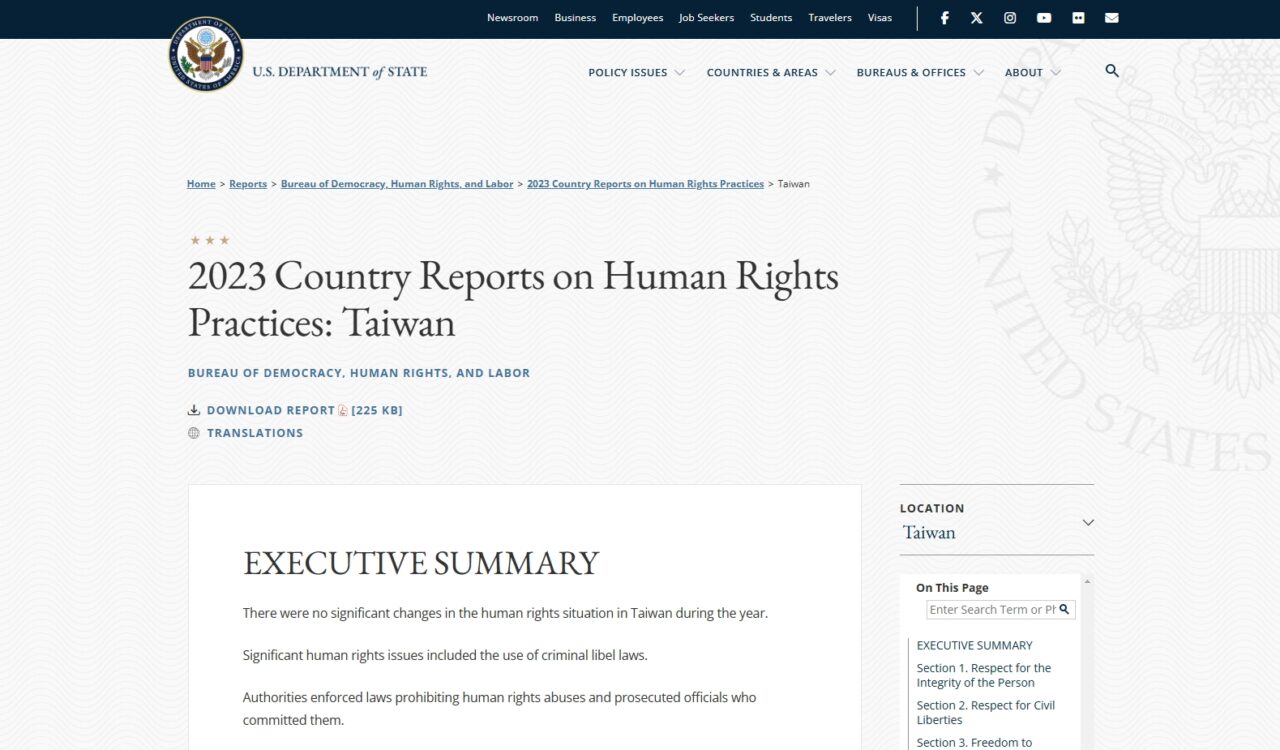
The U.S. State Department recently released its 2023 Country Reports on Human Rights Practices, assessing the global human rights situation. While acknowledging Taiwan’s commendable performance in upholding core human rights values such as democracy and judicial independence, the report also highlighted several areas in need of improvement, urging the Taiwanese government and society to sustain efforts.
Freedom of Speech Remains a Human Rights Concern
The report commended Taiwan for having an independent media, an effective judiciary system, and a democratic political structure that ensure freedom of speech and press freedom. However, it noted that some speech-related cases still involve litigation, reflecting that criminal defamation remains a significant human rights impediment. For instance, last year, several high-ranking officials from the ruling party resigned amid sexual harassment scandals. One party staffer who accused a superior of harassment on Facebook was criticized instead. Meanwhile, a renowned writer and an opposition lawmaker were also accused of sexual misconduct. Such cases sparked widespread societal discussions, underscoring that even in democratic Taiwan, women still face workplace sexual harassment and gender discrimination.
Apart from free speech and gender equality issues, the report also expressed concerns over indigenous rights. Although Taiwanese law grants rights to indigenous peoples, some indigenous groups have criticized the privatization of vast swaths of their traditional lands, preventing them from participating in the development and utilization of these territories.
Labor Union Organizing Rights Remain a Vulnerability
Regarding labor rights, while acknowledging Taiwan’s legal protections for organizing unions, the report pointed out challenges. Many large corporations frequently employ various tactics to obstruct employees from forming enterprise unions, rendering such unions virtually non-existent in the tech industry. Furthermore, the report mentioned issues surrounding the protection of migrant workers’ rights. Although Taiwan has implemented some policy measures to safeguard migrant workers, advocacy groups have criticized that migrant workers often refrain from reporting employer violations due to fears of termination. On the human rights of fishermen, the report stated that Taiwanese fishermen frequently endure abuse and poor working conditions, but the understaffed Ocean Affairs Council lacks the capacity to effectively monitor labor conditions on all Taiwanese distant-water fishing vessels.
Challenges to Press Freedom in Taiwan
The U.S. human rights report recognized Taiwan’s independent media and press freedom but noted that journalists still face restrictions and threats in their work.
It specifically highlighted that some Taiwanese media outlets have difficulty publishing content critical of China because their parent companies have business footprints in China, making them susceptible to pressure from Beijing to self-censor. Additionally, China has attempted to influence media outlets with differing perspectives by intervening in Taiwanese companies’ advertising budgets.
Domestically, Taiwan’s criminal defamation laws pose a significant obstacle to journalists exercising press freedom. The report cited a case last year where the campaign chief of a ruling party presidential candidate sued a television station and reporters for defamation over their reporting on allegations that the candidate was considering cooperating with other opposition parties. While Taiwanese law protects “fair commentary on matters of public interest” from defamation charges, many commentators and human rights groups have called for defamation to be treated entirely as a civil matter to avoid intimidating media freedom of speech.
This year, there have even been voices questioning the constitutionality of criminal defamation laws, arguing that they infringe upon freedom of expression. Another concern for journalists is the media exposure of several sexual harassment cases involving political figures and cultural celebrities last year. Some cases alleged that the accused not only sexually harassed female reporters but also acted aggressively toward those who refused to cooperate. These incidents sparked heated discussions and highlighted that journalists may face gender-based violence and workplace bullying while on the job.
While Taiwan’s press freedom is considered advanced in the region, the State Department report still pointed out the authoritarian shadows and risks faced by journalists. It urged the Taiwanese government to provide more robust legal and practical protections for journalists to truly uphold the spirit of press freedom.
Although Taiwan has a solid foundation in democratic freedoms and civil and political rights, the human rights report identified several pending issues related to gender, ethnicity, and labor that require improvement. Some civil society groups believe the Taiwanese government should continue to strengthen relevant laws and policies while actively addressing societal prejudices and discrimination against these vulnerable groups.
A large number are flocking to the Eat News for quality news every day, and readers in Taiwan, United States, United Kingdom, India, Japan, France, Pakistan, China, Malaysia and more, now support us financially.
In these chaotic, perilous times, an independent, truth-seeking news organisation like the Eat News is essential. We believe everyone deserves access to trustworthy information. That’s why we choose to keep our reporting open for all readers, regardless of where they live or what they can afford to pay.
The Eat News has no shareholders or billionaire owner, meaning our journalism is free from influence and vested interests – this makes us different. Our editorial independence and autonomy allows us to provide fearless investigations and analysis of those with political and commercial power. We can give a voice to the oppressed and neglected, and help bring about a brighter, fairer future.
If there were ever a time to join us, it is now. You have the power to support us through these volatile economic times and enable our journalism to reach more people, in all countries.
Every contribution, however big or small, makes a difference. Support the Eat News for better reporting.
Support the Eat News ➔


