

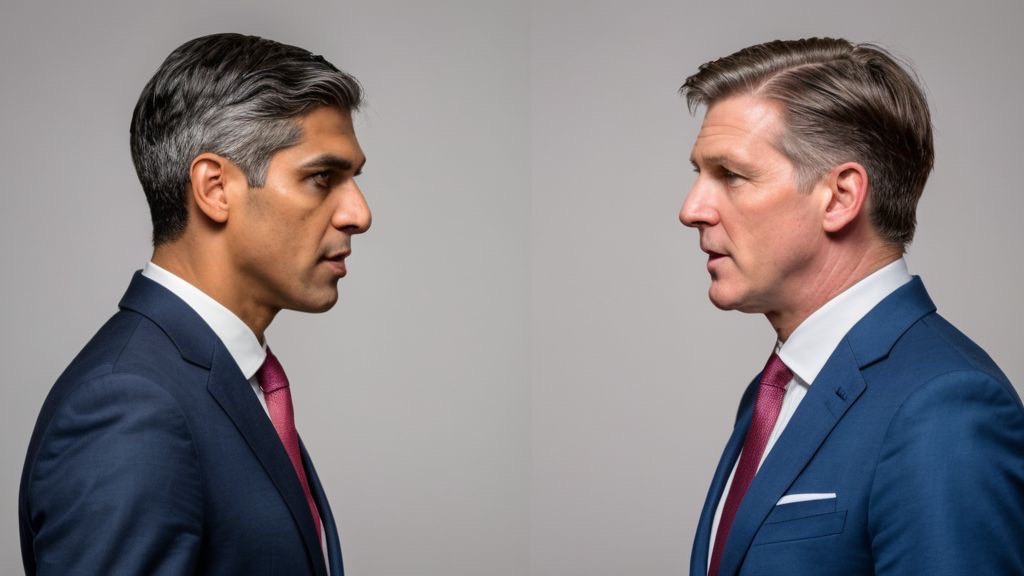
- The UK electoral debate between Conservative Rishi Sunak and Labour's Keir Starmer highlighted stark contrasts in their visions, potentially shaping the future of Great Britain.
Evidently, the recently organised UK electoral debate was fascinating as Conservative Rishi Sunak locked horns against Labour’s Keir Starmer. Despite being very hardworking, intelligent, and quite technocratic both in nature and rhetoric, the first leaders’ debate highlighted the stark contrast in their visions, which may define the future of Great Britain.
The two speakers performed characteristic politeness, formal BP-indicated fluency in English as a first language, and strong technical skills. It was a typical cinematic experience. In his first appearance, two men dressed in stylish navy-blue suits and immaculately pressed white shirts were featured, one with a neat royal blue tie around his neck and the other a mauve one. While their momentum, tone and mannerisms were indeed quite similar, they differed on key issues, indicating that they wanted different things and represented a fundamentally different political divide.

One of the critical moments of the debate was when Julie Etchingham asked both of the leaders if they were ready to pay for the treatment of a sick relative and skip the queue for public healthcare. Yes or no? Sunak responded with ‘yes’, uttering in a low but assertive voice, which can be attributed to his principle of liberalism in the sense of people’s freedom to choose. Even worse is that Starmer refuted such claims; such denial stemming from his love and dedication originated from the family’s background in the NHS. This brief exchange conveniently summed up the philosophical stand of the Conservatives with their penchant for personal freedom and the Labour’s passion for public service.
Born and raised by working-class parents who were both in the NHS serving as a general practitioner and pharmacist, respectively, Sunak enjoyed the fruits of their Labour to land himself in the choices—administered in a private school and top Wall Street investment banking firm. For one, this background provides a foundation for his policy and personal accountability stance.
On the other hand, Starmer’s story of coming from a working-class background – his father was a toolmaker, and neither of his parents went to university. This goes to show his life-long dedication to public service, which further underscores the fact that prior to becoming the leader of Britain’s Labour Party, he was the head of the country’s prosecution service. Though he was accorded the title of ‘Sir’ in the earlier campaigns, Starmer maintained a discrete distance away from this title, seeing it as elitism.
In the debate, Sunak overcame his opponents by presenting himself as someone with linkages and understanding of the community members who are experiencing pressure in the face of financial insecurity. A man of means given further dimension by his seemingly removed lifestyle, suggesting he is far removed from having to worry about many fundamentals of life, was apparent when he initiated an ill-at-ease exchange with a member of the audience who was concerned about escalating fuel prices.
Starmer, supported by the results of fresher polls showing him leading with a considerable Labour advantage, was receiving benefits from numerous immediate public safety and centrist approaches. Nonetheless, the work of Ed Miliband remains daunting because he has to persuade the electorate that Labour’s course of action could entail a change in fiscal regime. It is A move the voters find undesirable and necessary to correct the Conservative fiscal policies responsible for the current state of the economy.
In an exclusive with Eat News, political analyst Michael Lawn said, ‘There is a considerable ideological gap between Sunak and Starmer. Their different approaches to governing have deeper commitments that directly impact the country’s trajectory. Voters will have to decide between two very different approaches to economic and social policy, making this one of the most significant elections in the UK.”
Both leaders, who still dreaded a direct confrontation over personalities and wanted to avoid discussing their own persona, shifted the focus considerably on the mantle of policy issues. Sunak continuously pointed to the risks of a Labour-led government. At the same time, Starmer maintained that the Conservative handling of the economy, especially in the stewardship of Liz Truss, was the cause of the current state of affairs.
As the debate unfolded, the overriding idea was about who was honourable and the clear policy difference between the two. Aspects of personality appear commonplace in most countries where politics are arranged; this new inclination toward policy may force the voters to think and analyse more when casting their votes.
So, the exchange between Rishi Sunak and Keir Starmer was much more than a FASHION statement of dressing and mannerisms of Conservative and Liberal. It revealed the fundamental beliefs that shall shape their agendas once in office, shaping public perception of who to vote for. In a way, the direction of the unfavourable outcome that these philosophical differences could take sums up the central decision the UK electorate must make. Specifically, between liberty and collective good, between small-L conservative and Keynesian economics.
While the UK election and its outcome have major repercussions for many of the country’s economic policies as voters go to polls, it may well alter the fundamental basis on which Britons are governed.
A large number are flocking to the Eat News for quality news every day, and readers in Taiwan, United States, United Kingdom, India, Japan, France, Pakistan, China, Malaysia and more, now support us financially.
In these chaotic, perilous times, an independent, truth-seeking news organisation like the Eat News is essential. We believe everyone deserves access to trustworthy information. That’s why we choose to keep our reporting open for all readers, regardless of where they live or what they can afford to pay.
The Eat News has no shareholders or billionaire owner, meaning our journalism is free from influence and vested interests – this makes us different. Our editorial independence and autonomy allows us to provide fearless investigations and analysis of those with political and commercial power. We can give a voice to the oppressed and neglected, and help bring about a brighter, fairer future.
If there were ever a time to join us, it is now. You have the power to support us through these volatile economic times and enable our journalism to reach more people, in all countries.
Every contribution, however big or small, makes a difference. Support the Eat News for better reporting.
Support the Eat News ➔


