

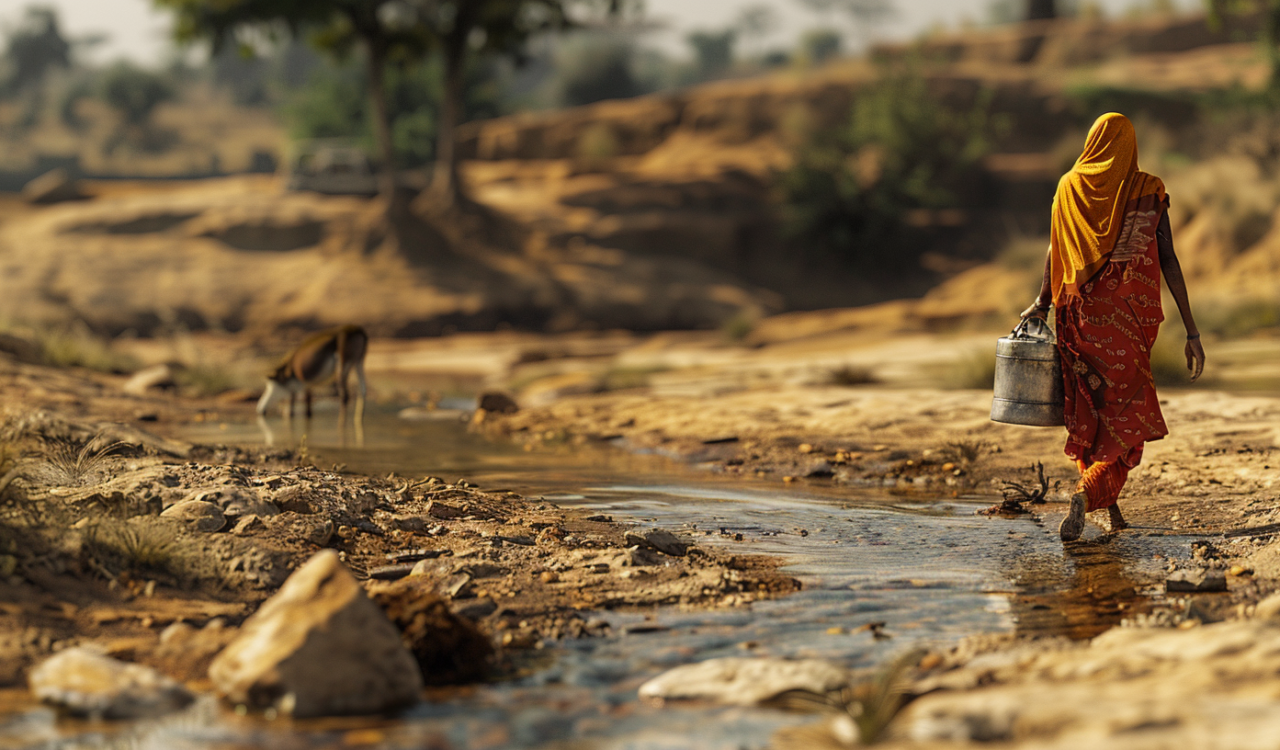
- India has recorded its highest temperature of 52.3 degrees Celsius in New Delhi, leading to severe heatwave conditions.
India has recorded highest temperature, with 52.3 degree Celsius (126.1 Fahrenheit) in New Delhi, beside constant warnings of week-long heatwave. People in North India are facing scorching heat and are being advised to not step out of home during day, if not necessary. The Indian Meteorological Department (IMD) reported severe heatwave conditions and recorded highest temperature in the suburbs of New Delhi, Mungeshpur during afternoon that smashed the previous national record of hitting 51 degree Celsius (124 Fahrenheit) in Rajasthan’s town Phalodi, in 2016. The heatwave warnings are commonly issued once the temperature reaches above 45 degree Celsius, which this time has begun since May. While people are taking precautions, water shortage in the capital of India is affecting people during this crucial time. New Delhi authorities warned the risk of water shortage and cutting of water supply to some areas. Over the past weeks, Haryana has reduced Delhi’s share of water from the Yamuna by 100 million gallons per day, however situations has improved. But residents of Delhi are still struggling with shortage of water under boiling temperature in the city.
This is not the first-time people are facing acute shortage of water in summers. Every year, demands surges in offices, homes, farms and with the years passing and prolonged heatwaves are making situation worse as it has further strained water resources across the nation. According to Moody’s ratings, India’s escalating water shortage, exacerbated by high consumption amid rapid economic growth and frequent natural disasters, threatens the nation’s sovereign credit strength, quoted Mint. Delhi authorities recently announced that water supply will be limited to some areas, and instead of twice it will be once in a day. Water Minister Atishi said, ‘I know that where water is being supplied twice a day, people will be trouble if it is cut off for once a day, but I appeal to all Delhiites that we should not think only about ourselves. We should think about everyone’, quoted Economic Times. She also called it a ‘collective responsibility’ to avoid wasting water and suggested measures such as to wash vehicles with one pipe, avoid overflowing tanks and if these measures are not followed, government might issue fines for water wastage in future.
Jaya is a Delhi resident lives in Southern part of the city. She shared her difficulties of being a big family of 7 members amid water shortage. ‘It is not easy for us to live in such dreadful conditions. My two children and my husband go to work, my old in laws cannot walk and stays at one corner of the house, and since its summer vacations, we have our relatives from Bihar for two months. How am I going to manage without water? Water is a basic necessity, we need it for cooking, taking shower, drinking, and it cannot be adjusted or can be adjusted. This year, temperature is adding on to our challenges’, said Jaya. She recently got a second-hand cooler from a known, and still hasn’t used it due to shortage of water. Minister Atishi was on hunger strike as a protest because of Haryana’s refusal to release Delhi’s share of water, but due to deteriorating health conditions, she was taken to hospital where her fast ended. On asking Jaya, does she think all this will help people facing water challenges on ground, to which she told EAT news, ‘Sitting on hunger strike won’t gives us water. These ministers know how to do politics and does everything for personal interest. They are receiving 24/7 water supply, they are not on ground and are affected in any way like us.’ Furthermore, she said that elite people benefits from every situation because of the support they get due to coming from a same community as decision makers do, however marginalized people suffer and are always taken for granted.
According to policy analyst Uttam Gupta in his article published by Daily Pioneer, mentioned water shortage in Delhi is completely man made and mistake from Delhi government are adding on to the fundamental issue in this situation. ‘Unable to manage water supplies from the rivers viz. Yamuna, Ravi-Beas, Ganga and so on, the Delhi government is now increasing dependence on ground water which currently contributes a little more than 10 per cent almost 100 per cent increase over the level five years ago’, Daily Pioneer quoted Uttam Gupta. He also added, huge imbalance between the demand and supply, the gross mismanagement and irregularities in Delhi’s water supply system also changed the whole outline of water availability in Delhi.
Jaya stands everyday for hours in queue to store water for further day. She said, ‘Imagine waking up early morning to stand in a queue, and listen people fighting, abusing or frustrated, how a morning can be good?’ Jaya’s neighborhood has been promised to get normal supply of water soon.
A large number are flocking to the Eat News for quality news every day, and readers in Taiwan, United States, United Kingdom, India, Japan, France, Pakistan, China, Malaysia and more, now support us financially.
In these chaotic, perilous times, an independent, truth-seeking news organisation like the Eat News is essential. We believe everyone deserves access to trustworthy information. That’s why we choose to keep our reporting open for all readers, regardless of where they live or what they can afford to pay.
The Eat News has no shareholders or billionaire owner, meaning our journalism is free from influence and vested interests – this makes us different. Our editorial independence and autonomy allows us to provide fearless investigations and analysis of those with political and commercial power. We can give a voice to the oppressed and neglected, and help bring about a brighter, fairer future.
If there were ever a time to join us, it is now. You have the power to support us through these volatile economic times and enable our journalism to reach more people, in all countries.
Every contribution, however big or small, makes a difference. Support the Eat News for better reporting.
Support the Eat News ➔


