

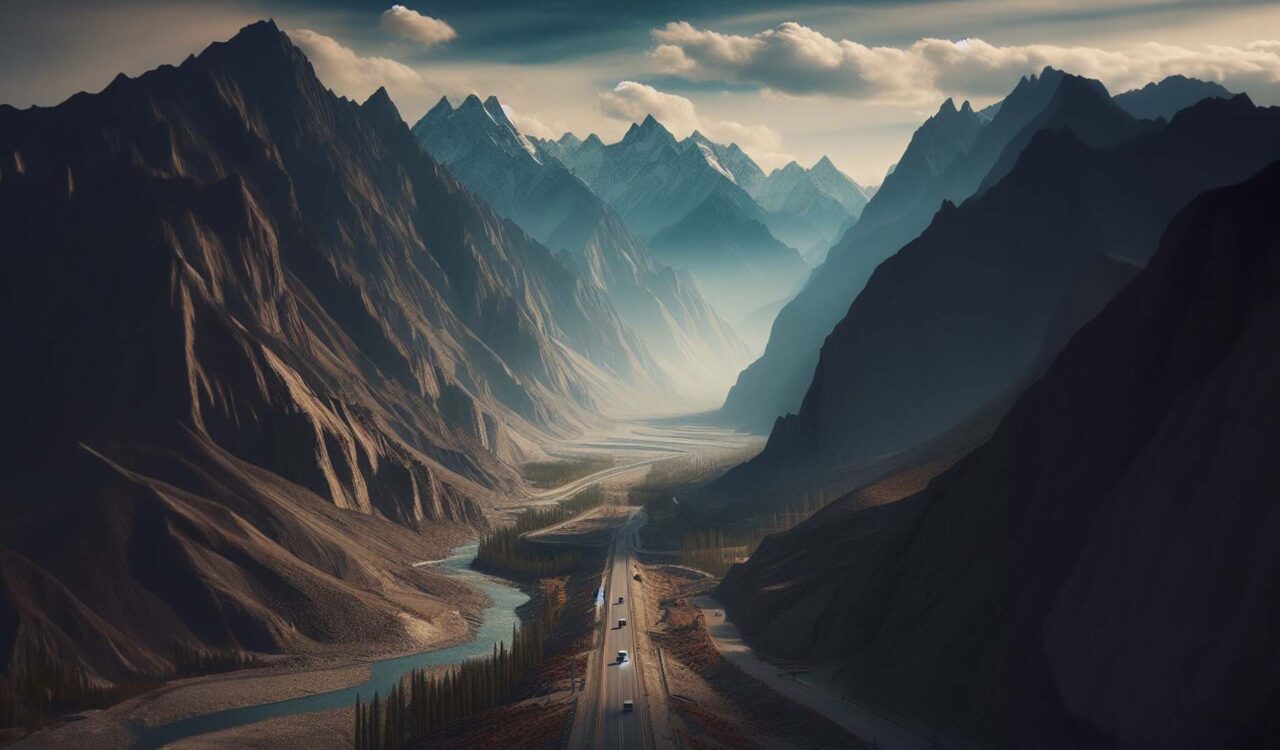
The Karakoram Highway is a breathtaking 1300-kilometer route that passes through some of the most astonishing rock formations on Earth. This hidden gem of a roadway, once an integral part of the historic Silk Road, remains a dreamlike passage known to only a fortunate few. Dive into the story of this engineering marvel, where 24,000 Pakistani and Chinese laborers worked persistently for two decades to transform it into a lifeline of trade, tourism, and accessible travel, connecting Pakistan and China.
Despite the summer in Pakistan, the snow glisters on the 7,000-meter-high peaks, and the melting water of the glacier falls in the form of a waterfall in the river that transits through the Hunza valley. This valley was named “Shangrila” by the British novelist James Hilton in his novel “Lost Horizon” published in 1933, referring to the stunning but fictional place of Tibet’s Kunlun Mountains.
The 1300 km long road starts from the small town of Hasan Abdal near the federal capital of Pakistan Islamabad and goes to Xinjiang in China via the world’s highest paved road at Khunjarab at an altitude of 4700 meters. The most interesting part of this road is the 194 km which is in the Hunza Valley. This area is surrounded by the Karakoram Mountains, due to which this road was named the Karakoram Highway.
The area is unbelievably stunning where you can see transparent glaciers, lakes, and snow-capped peaks all around the trek. This journey is fascinating and alluring but another important thing that makes the highway special is the people of Hunza, their hospitality, and the traditions of this valley.
Located between the Xinjiang and Wakhan Corridors in Gilgit-Baltistan, Hunza was cut off from the rest of the world until the 20th century. The local population consists of Brushu and Wakhi people and has its own language, music, and culture that cannot be found anywhere else in Pakistan or around the world.
The Karakoram Highway has made travel to the Hunza Valley easier for the world, but it also had some negative impacts on the environment and forced the majority of the local people to abandon their traditional lives. However, some local people are now working hard to keep the unique traditions of Hunza alive. Now few people in Hunza Valley celebrate the “Jinani” festival associated with the arrival of spring.
Gojal, a nearby area (the other part of Hunza) that shares a culture similar to Central Hunza, speaks the Wakhi language, and it is believed that natives living here migrated from the Wakhan Corridor hundreds of years ago. The Wakhan Corridor is a narrow strip of land in northeastern Afghanistan that extends to the east, forming a border with China, Pakistan, and Tajikistan. This corridor was created during the 19th century as a buffer zone between the British Empire (in India) and the Russian Empire (in Central Asia) during the period known as the “Great Game”, when the two empires competed for influence in the region.
Before the highway was opened, it used to be a journey of several days between two parts of Hunza. Now it’s just an hour’s drive with the blue-colored Attabad Lake welcoming travelers and tourists to the area. Natural-looking Attabad Lake is an artificial lake that was born due to a tragedy. On January 4, 2010, a flash flood blocked the Hunza River, swamping several villages, and resulting in an artificial lake. The lake, surrounded by luxury hotels, is also named Attabad after a village that was destroyed in 2010. Now this lake has become a symbol of modernization and innovation in Hunza Valley. In 2015, five tunnels were completed under the name of China-Pakistan Friendship on the Karakoram Highway for ease of travel, which makes you feel like you are in a busy city in the world, not in a remote area.
It is said that the Karakoram Highway was built on the route of the ancient Silk Road; the same difficult mountain path through which caravans to and from Central Asia and China passed in ancient times.
Even before the construction of the Karakoram Highway in the northern areas of Pakistan, this pathway used to be a major source of political, social, business, and other connections with China in the region. However, its business importance is not only limited to the trade between China and Pakistan, but the reconstruction of the Karakoram Highway has benefited the local residents the most. The importance of the Karakoram Highway for Pakistan cannot be denied but this road is a “lifeline” for Gilgit-Baltistan.
According to data, after the construction of the Karakoram Highway in 2015, the number of local tourists visiting the area increased by more than 800%, while the number of international tourists has also doubled. The expansion and rehabilitation of the Karakoram Highway not only boosted tourism but also provided access to new markets for local fruits, dry fruits, and other locally grown/produced goods.
A large number are flocking to the Eat News for quality news every day, and readers in Taiwan, United States, United Kingdom, India, Japan, France, Pakistan, China, Malaysia and more, now support us financially.
In these chaotic, perilous times, an independent, truth-seeking news organisation like the Eat News is essential. We believe everyone deserves access to trustworthy information. That’s why we choose to keep our reporting open for all readers, regardless of where they live or what they can afford to pay.
The Eat News has no shareholders or billionaire owner, meaning our journalism is free from influence and vested interests – this makes us different. Our editorial independence and autonomy allows us to provide fearless investigations and analysis of those with political and commercial power. We can give a voice to the oppressed and neglected, and help bring about a brighter, fairer future.
If there were ever a time to join us, it is now. You have the power to support us through these volatile economic times and enable our journalism to reach more people, in all countries.
Every contribution, however big or small, makes a difference. Support the Eat News for better reporting.
Support the Eat News ➔


