


Editors‘ Note:
This article was compiled and written by OpenAI’s ChatGPT Plus and reviewed by the human editors of Eat News.
Former President of the Republic of China, Ma Ying-jeou, mentioned during a meeting with the Communist Party Secretary of Jiangsu Province, Xin Changxing, in Nanjing, China, that he promoted cross-strait exchanges during his tenure as the “President of Taiwan”, creating the “most peaceful and prosperous phase” in more than 70 years of separate governance across the Taiwan Strait.
Before meeting Xin Changxing, Ma Ying-jeou referred to his “former president” status during a group interview after visiting the Sun Yat-sen Memorial Hall. In contrast, Xin Changxing addressed him as “Mr. Ma Ying-jeou” during the meeting but also mentioned Ma Ying-jeou’s former roles as the leader of the Kuomintang and the “former leader of the Taiwan region”.
Ma Ying-jeou stated, “I hope we can put aside disputes and reach consensus on as many issues as possible. That is why I promoted cross-strait exchanges during my tenure as Taiwan’s president, signing 23 agreements in eight years, covering most issues affecting people’s lives and creating the most peaceful and prosperous phase in more than 70 years of separate governance across the strait.”
Ma Ying-jeou mentioned that “after meeting with me in Singapore, Mr. Xi (Communist Party General Secretary Xi Jinping) emphasized that he hopes for spiritual unity across the strait, which is almost consistent with my past emphasis on narrowing psychological distance.”
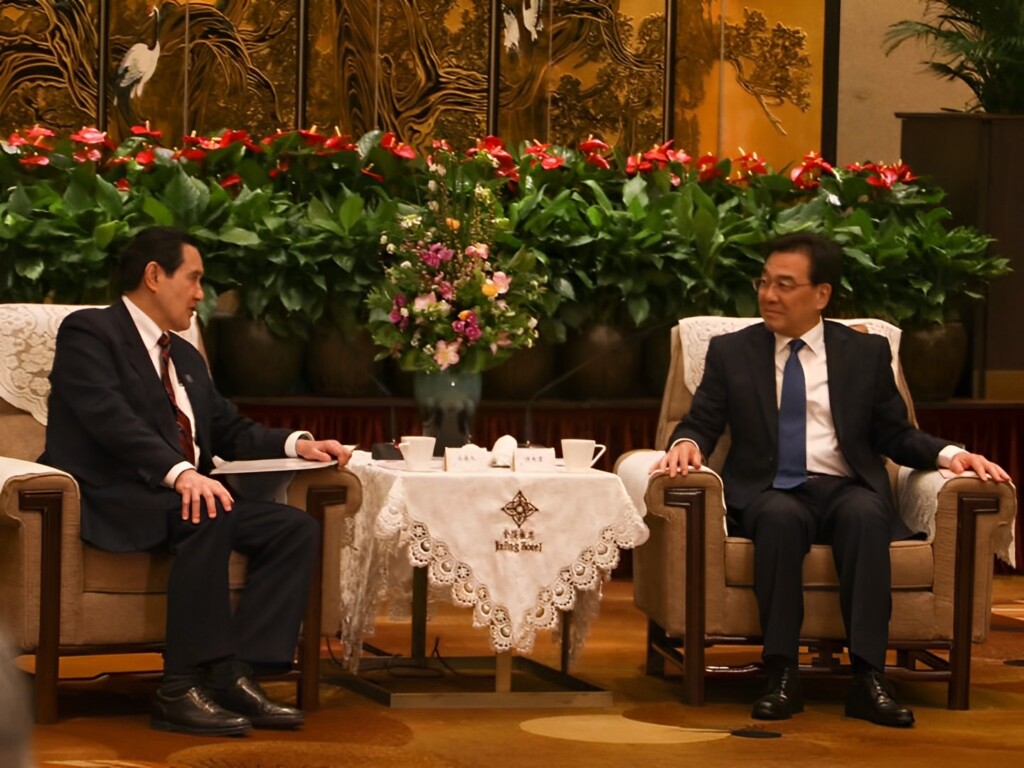
He said that establishing mutual trust is essential for cross-strait exchanges to prevent the risk of war. He hopes that the mainland will gain a better understanding of the psychological state of the Taiwanese people so that everyone can work together to prevent war and seek harmony.
Ma Ying-jeou mentioned the past common political foundation of the “1992 Consensus,” which allowed for mutual trust, dispute shelving, and the establishment of direct flights between both sides.
Ma Ying-jeou said that since joining the government’s cross-strait work in 1987, when he was 37, he has shown great sincerity towards cross-strait affairs. He believes that this work is worthwhile, and policies such as direct flights and others have benefited people on both sides.
After stepping down as president, he became a chair professor at Soochow University and recognized the importance of cross-strait youth exchanges for both Taiwan and the mainland.
Xin Changxing referred to Ma Ying-jeou as “Mr. Ma Ying-jeou”. He said, “Mr. Ma Ying-jeou chose Nanjing as the first stop on his maiden visit to the mainland.” Over the years, “whether as the former leader of the Kuomintang or the former leader of the Taiwan region”, Ma Ying-jeou has always adhered to the 1992 Consensus and the One-China Principle, opposed Taiwan independence, actively promoted peaceful development of cross-strait relations, and encouraged exchanges and interactions between both sides. “We highly appreciate this.”
However, Chinese netizens were unhappy with Ma Ying-jeou referring to himself as the “former president” and posted many irrational comments on Weibo, a Chinese social media platform. Some comments included, “What former thing?” “Talking about peace without mentioning reunification is deceitful,” “Daring to call himself the ‘former president’ implies two countries,” “Peace is premised on unification; don’t confuse the primary and secondary orders,” “Hidden independence supporter,” “Openly saying this is subverting the regime,” “Maybe the Taiwan Affairs Office has been infiltrated by Taiwan independence forces, taking the national salary but leaning towards the other side,” and “The Republic of China has already ended in the mainland, how dare he come here and call himself the former president, it’s inappropriate.”
These reactions demonstrate the sensitivity surrounding cross-strait relations and the differing opinions on the matter. Despite the disagreements, Ma Ying-jeou’s visit to mainland China reflects an effort to foster dialogue and build mutual understanding between the two sides, in the hope of promoting peace and prosperity across the Taiwan Strait.
A large number are flocking to the Eat News for quality news every day, and readers in Taiwan, United States, United Kingdom, India, Japan, France, Pakistan, China, Malaysia and more, now support us financially.
In these chaotic, perilous times, an independent, truth-seeking news organisation like the Eat News is essential. We believe everyone deserves access to trustworthy information. That’s why we choose to keep our reporting open for all readers, regardless of where they live or what they can afford to pay.
The Eat News has no shareholders or billionaire owner, meaning our journalism is free from influence and vested interests – this makes us different. Our editorial independence and autonomy allows us to provide fearless investigations and analysis of those with political and commercial power. We can give a voice to the oppressed and neglected, and help bring about a brighter, fairer future.
If there were ever a time to join us, it is now. You have the power to support us through these volatile economic times and enable our journalism to reach more people, in all countries.
Every contribution, however big or small, makes a difference. Support the Eat News for better reporting.
Support the Eat News ➔


