
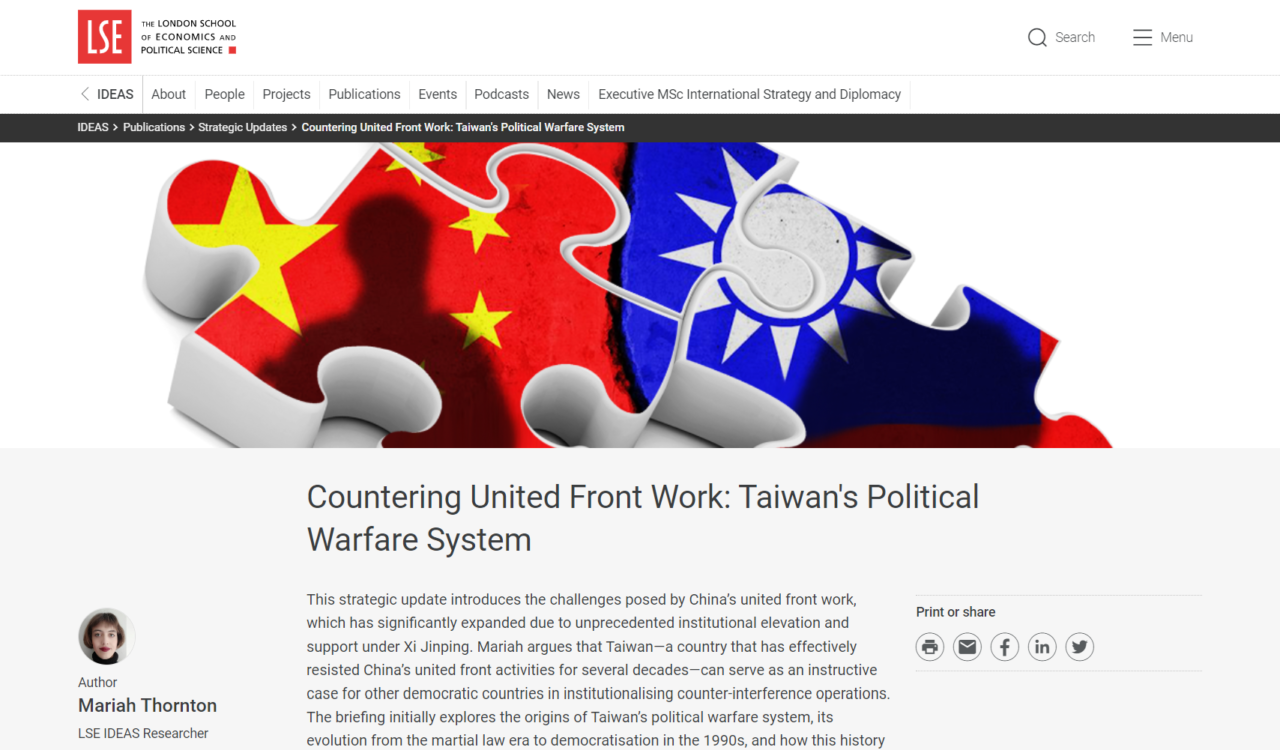
On March 21, 2023, LSE IDEAS, the foreign policy think tank of the London School of Economics and Political Science, published an article titled “Countering United Front Work: Taiwan’s Political Warfare System,” written by Mariah Thornton, a Ph.D. student in the Department of International Relations at the LSE. When the article was first published, Ross Feingold, the former Asia Chairman of Republicans Abroad, identified some errors, including changing the year of the Republic of China government’s retreat to Taiwan from 1949 to 1947 and the establishment of a new government called the “Republic of China” in Taiwan by the KMT after losing the Second Chinese Civil War. Although these errors have been corrected and republished, I still found some oversights in the article.
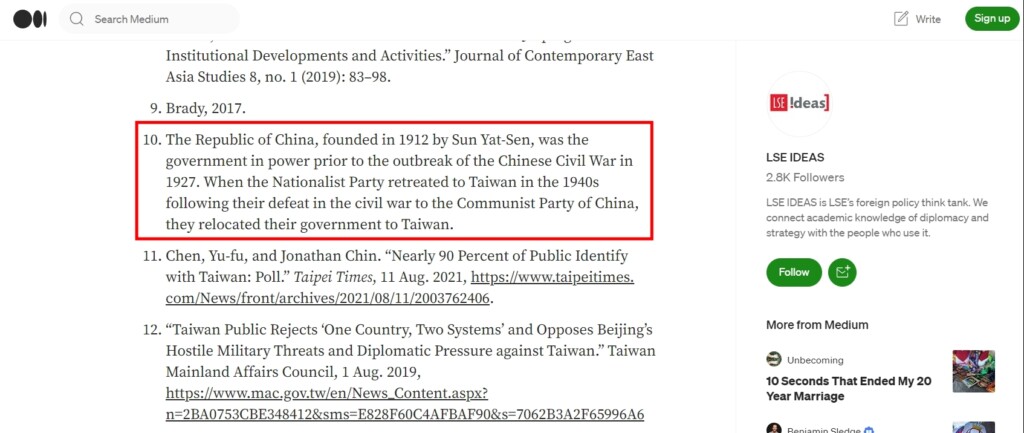
- Footnote 10 mentions that the Republic of China was the ruling government before the outbreak of the Chinese Civil War in 1927, but modern China experienced two civil wars. The first one took place between 1927 and 1937, with the Chinese Nationalist Party (Kuomintang, KMT) referring to it as the “Bandit Suppression” campaign and the Chinese Communist Party (CCP) calling it the “Long March.” However, after the first Chinese Civil War, the Republic of China remained the ruling government of mainland China until 1949.
- The article states that “Sun Yat-Sen Thought emphasized democracy, human rights, the rule of law, and the value of freedom,” which is not entirely accurate. Taking Sun Yat-sen’s “Three Principles of the People” as an example, the three main pillars are nationalism, democracy, and people’s livelihood. Nationalism is based on the theory of constructing the Chinese nation with the “Five Races Under One Union”; democracy is the theory of establishing the separation of powers, the Five-Power Constitution, and local self-governance, which also includes the French Revolution slogans of liberty, equality, and fraternity; people’s livelihood emphasizes the ideas of equal land rights and the publicization of price increases. Sun Yat-sen even mentioned in the first article on people’s livelihood that “the Principle of People’s Livelihood is socialism, also known as communism, which is the ideal of Great Harmony.” These contents differ significantly from the values of democracy, human rights, the rule of law, and freedom mentioned in the article.
- The article seems to confuse “The Republic of China” and “Taiwan.” The title is “Taiwan’s Political Warfare System,” but before 1945, Taiwan was not ruled by the Republic of China but was part of the Empire of Japan. However, the text repeatedly refers to the history of mainland China before 1945 rather than the history of Japanese Taiwan, which is a research blind spot.
In addition to the above errors, the article also lacks mention of two important institutions in the past political warfare system of the Republic of China: the Investigation and Statistics Bureau of the Military Affairs Commission of the Nationalist Government and the Statistics and Investigation Bureau of the Central Executive Committee of the Kuomintang. Apart from being intelligence agencies during the two Chinese Civil Wars and the Second Sino-Japanese War, these two institutions were also responsible for purging CCP spies within the Nationalist Government or the KMT and removing pro-Japanese politicians and ideologies within the KMT. Only after the Republic of China’s government fled to Taiwan in 1949 did Chiang Ching-kuo spearhead the integration of intelligence and security units.
A large number are flocking to the Eat News for quality news every day, and readers in Taiwan, United States, United Kingdom, India, Japan, France, Pakistan, China, Malaysia and more, now support us financially.
In these chaotic, perilous times, an independent, truth-seeking news organisation like the Eat News is essential. We believe everyone deserves access to trustworthy information. That’s why we choose to keep our reporting open for all readers, regardless of where they live or what they can afford to pay.
The Eat News has no shareholders or billionaire owner, meaning our journalism is free from influence and vested interests – this makes us different. Our editorial independence and autonomy allows us to provide fearless investigations and analysis of those with political and commercial power. We can give a voice to the oppressed and neglected, and help bring about a brighter, fairer future.
If there were ever a time to join us, it is now. You have the power to support us through these volatile economic times and enable our journalism to reach more people, in all countries.
Every contribution, however big or small, makes a difference. Support the Eat News for better reporting.
Support the Eat News ➔


