

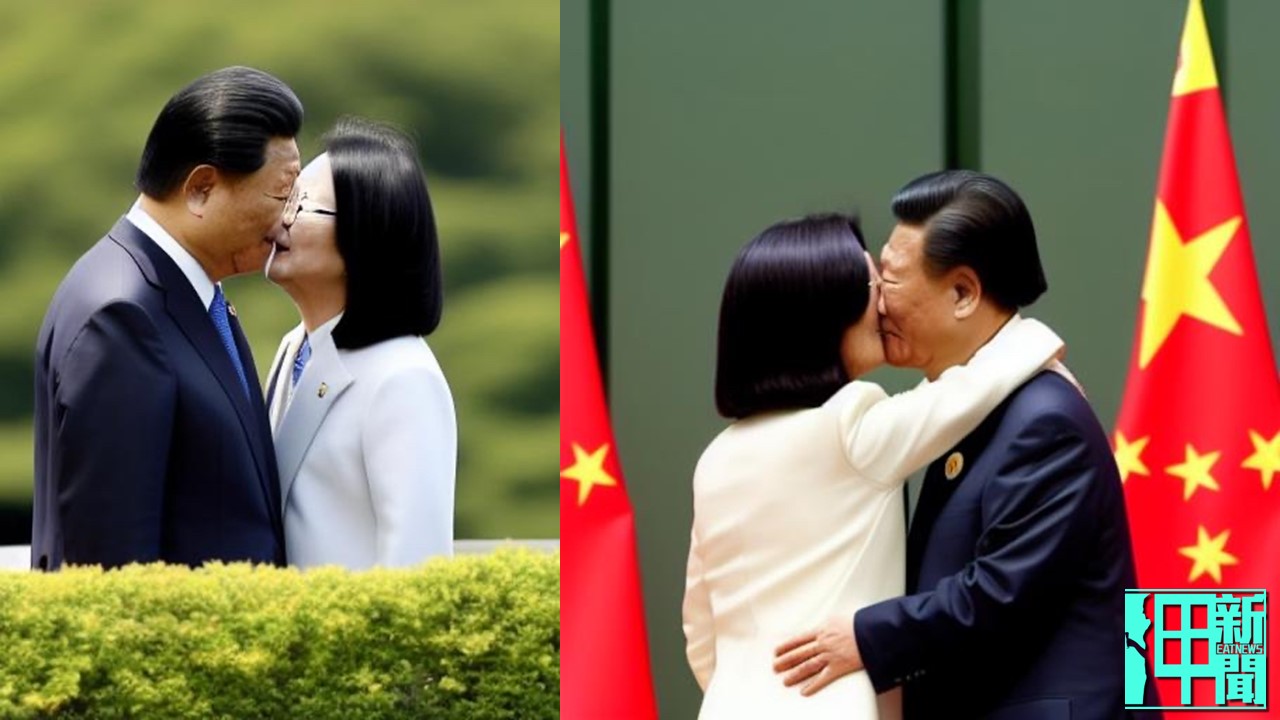
Editors‘ Note:
This article was compiled and written by OpenAI’s ChatGPT Plus and reviewed by the human editors of Eat News.
Xi Jinping’s successful re-election as Chairman of the People’s Republic of China and Chairman of the Central Military Commission marks the beginning of his third term. He has already been re-elected as General Secretary of the Chinese Communist Party, and has now completed his “re-election” as Chairman. His third term is considered to be the end of the collective leadership system of the Chinese Communist Party after Deng Xiaoping and may also signify the official return of “strongman politics” in the history of the CCP. At the same time, the Republic of China on Taiwan’s President Tsai Ing-wen has proposed a plan to restore cross-strait air passenger services and will consider the conditions proposed by China to restore flights, demonstrating Taiwan’s goodwill. The most important consideration for restoring cross-strait air passenger services is said to be meeting the demands of the people.
Xi Jinping’s “trinity” re-election
The 69-year-old Xi Jinping is the son of senior Chinese Communist Party member Xi Zhongxun and is considered to be a member of the “princeling faction” of the Chinese Communist Party. He has held senior positions in Fujian, Zhejiang, and Shanghai, and became General Secretary of the Communist Party of China in 2012, and was elected Chairman in 2013. He emphasizes that China must achieve the “great rejuvenation of the Chinese nation” and has launched an anti-corruption campaign with the idea of “hitting both tigers and flies”, during which he overthrew several former elders and competitors.
Xi Jinping’s position in the Chinese political system is very high, relying mainly on the leadership positions he holds in the party and the military to gain power. However, he has also used the chairmanship to showcase China’s diplomatic image, emphasizing China’s international status and great power image. In terms of foreign policy, Xi Jinping has taken a more confident and tough stance, pursuing China’s authoritative position in international affairs.
Xi Jinping’s re-election has been unanimously passed by nearly 2,900 Chinese legislators. His third term is seen as an important turning point that will not only affect China’s future development but may also have an impact on the global political situation. Against the backdrop of a constantly changing global trade and security landscape, Xi Jinping’s foreign policy and attitude towards the United States may have significant implications for the world.
In China, Xi Jinping’s re-election has also sparked widespread discussion and attention. Some believe that his re-election marks a shift towards single-party leadership in Chinese politics and may also strengthen the Chinese government’s control and centralization. Others are concerned that Xi Jinping’s tough stance may provoke international disputes and conflicts, affecting China’s economy and international image.
Tsai Ing-wen calls for accelerating cross-strait exchanges
At the same time, ROC’s Tsai Ing-wen administration has extended an olive branch to the Xi Jinping regime. Regarding the issue of resuming flights across the strait, Executive Yuan political commissar and acting spokesperson Lo Ping-cheng stated that President Tsai Ing-wen pointed out at last year’s National Day that after the border between the two sides is unsealed, cross-strait healthy and sustainable exchanges will be gradually restored. In recent months, Taiwan has gradually relaxed restrictions on mainland visitors and resumed normal operations of the Kinmen-Matsu “small three links” ferry services. With the further easing of the pandemic, Premier Chen Chien-jen has requested that relevant agencies evaluate and plan for the resumption of cross-strait exchanges at all levels.
Lo Ping-cheng explained that the resumption of cross-strait air passenger services involves many factors, in addition to the epidemic situation. The plan proposed by the Mainland Affairs Council for the resumption of cross-strait air passenger services basically takes into account various considerations and tries to incorporate the conditions proposed by the mainland, demonstrating Taiwan’s goodwill. In the future, the resumption of cross-strait exchanges and the maintenance of order will require the joint efforts of both sides to show goodwill towards each other. Taiwan hopes to gradually increase goodwill and positive interactions between the two sides based on the resumption of flights.
Lo Ping-cheng emphasized that the most important consideration for the resumption of cross-strait air passenger services is to meet the needs of the people. This includes providing convenience for Taiwanese businesspeople and students to travel back and forth across the strait, reducing the inconvenience of long journeys by boat or land, saving operating costs for transportation companies, and meeting the needs of social exchanges. Chen Chi-mai has requested that relevant agencies make all necessary arrangements to ensure that this plan can be implemented smoothly as soon as possible.
In response to questions from the media, Lo Ping-cheng stated that Chen Chi-mai said during a legislative hearing the other day that China’s opening up of transportation was not sincere, but now Taiwan has changed its stance and wants to open up. Are there any turning points during this period? The Ministry of Transportation previously stated that the resumption of cross-strait exchanges has some prerequisites, such as the lifting of the ban on individual travel. Have there been any communications on these issues?
Lo Ping-cheng replied that the Mainland Affairs Council will hold a press conference this afternoon to answer all related questions. Considering the easing of the epidemic situation in Taiwan and the interaction between the two sides, this is a goodwill response proposed by Taiwan, hoping to accelerate or assist in relevant cross-strait exchanges.
A large number are flocking to the Eat News for quality news every day, and readers in Taiwan, United States, United Kingdom, India, Japan, France, Pakistan, China, Malaysia and more, now support us financially.
In these chaotic, perilous times, an independent, truth-seeking news organisation like the Eat News is essential. We believe everyone deserves access to trustworthy information. That’s why we choose to keep our reporting open for all readers, regardless of where they live or what they can afford to pay.
The Eat News has no shareholders or billionaire owner, meaning our journalism is free from influence and vested interests – this makes us different. Our editorial independence and autonomy allows us to provide fearless investigations and analysis of those with political and commercial power. We can give a voice to the oppressed and neglected, and help bring about a brighter, fairer future.
If there were ever a time to join us, it is now. You have the power to support us through these volatile economic times and enable our journalism to reach more people, in all countries.
Every contribution, however big or small, makes a difference. Support the Eat News for better reporting.
Support the Eat News ➔


